“In order for me to feel confident with one of my songs it has to really move me. That’s how I know that I’ve written a good song for myself – it’s when I start crying. It’s when I break out in tears in the vocal booth or in the studio, and I’ll need a moment to myself.
“You have to write about real life because otherwise how can you be relatable?”
—Adele (in an interview with New York Times)
# # # #
 A new study by Help Musicians UK shows that musicians are four times more likely than the general population to suffer hearing damage, and they have a significantly greater risk of developing tinnitus.
But few musicians are doing anything to lower the risk, the study found.
This is despite the fact that several major stars—including Ozzy Osbourne, Pete Townshend, Neil Young and Phil Collins—have publicly discussed their hearing loss and tinnitus in the past.
Now, Help Musicians UK—the leading UK charity for professional musicians of all genres—is setting out to educate musicians about the importance of looking after their ears. This follows recent research conducted by the organisation which found that 41% of musicians tend to experience hearing problems during their career, with the vast majority of them blaming their profession.
Nearly 700 professional musicians of all genres and types, singers and instrumentalists took part in the Help Musicians UK study. Just over 40% said they had experienced hearing loss and 20% said they did not know if they had been affected—meaning that less than half were confident their hearing was okay.
Some 78% of the musicians who reported a problem said they believed their career was a major factor in their hearing loss. 57% had suffered tinnitus, 21% hyperacusis (excessive sensitivity to sound) and 4% diplacusis (confusion in hearing pitch).
Despite the increased risk, 68% of the musicians surveyed said they hadn’t had a hearing test within the previous three years. And while 89% believed they should be using hearing protection, only 66% actually used it … and only 8% used it every time they played.
Nigel Hamilton, Help & Advice Manager at Help Musicians UK, said: “We know that hearing is one of the most important tools a musician has and when we started looking into musicians’ hearing more closely we realised how fragile it can be. Noise-induced hearing loss is completely preventable but also completely irreversible. Once it’s gone, it’s lost forever. As the leading charity for musicians, we felt we had to do something”.
As part of the #HearForMusicians campaign, Help Musicians UK is offering advice on hearing protection via its website, as well as providing financial support for hearing tests, hearing protection and hearing aids. Find out more HERE …
# # # #
![“HOW [NOT] TO WRITE A HIT SONG! - 101 COMMON MISTAKES TO AVOID IF YOU WANT SONGWRITING SUCCESS” is available from Amazon as a paperback and also as an eBook from Amazon’s Kindle Store, Apple's iTunes Store, Barnes and Noble's Nook store, and from KoboBooks.com.](https://thehitformula.com/wp-content/uploads/2013/05/how-not-to-write-a-hit-song-smashwords-cover-blog-widgit-188x282.jpg?w=131&h=190)
“How [Not] To Write A Hit Song! – 101 Common Mistakes To Avoid If You Want Songwriting Success” is available from Amazon as a US paperback, UK paperback and as an eBook from Amazon’s Kindle Store, Apple’s iTunes Store (Books/Arts & Entertainment/Music), Barnes & Noble’s Nook store, and from KoboBooks.
Read a FREE sample of the book HERE (USA) and HERE (UK), HERE (Australia) and HERE (Canada).

“Knock on every door, and write seven days a week. I know that sounds kind of harsh, but let that be your priority. Write, write and write some more.
“Your work ethic has got to be to the bone. Writing songs should be your first love, and give it all the time it needs until you feel like you’ve accomplished or gotten the song that you think is worthy of letting the world hear.”
—Lamont Dozier (in an interview with American Songwriter magazine)
# # # #
 To pave the way for a remixed, deluxe edition of his classic album Pipes of Peace, Paul McCartney has released a new remix of his 1983 hit with Michael Jackson, ‘Say, Say, Say’, which was originally produced by George Martin. The song became Jackson’s seventh Top 10 hit in a year.
In the video below, McCartney talks to Manic Street Preachers’ frontman James Dean Bradfield about what it was like to write songs such as ‘Say, Say, Say’ with Michael Jackson.
McCartney reveals that the song was written quickly, with Jackson and himself face-to-face around a piano in the former Beatle’s London office.
“It came very easily because I was excited to be writing with him and he was excited to write with me,” said McCartney. “We just popped off each other.”
![“HOW [NOT] TO WRITE A HIT SONG! - 101 COMMON MISTAKES TO AVOID IF YOU WANT SONGWRITING SUCCESS” is available from Amazon as a paperback and also as an eBook from Amazon’s Kindle Store, Apple's iTunes Store, Barnes and Noble's Nook store, and from KoboBooks.com.](https://thehitformula.com/wp-content/uploads/2013/05/how-not-to-write-a-hit-song-smashwords-cover-blog-widgit-188x282.jpg?w=119&h=172) “How [Not] To Write A Hit Song! – 101 Common Mistakes To Avoid If You Want Songwriting Success” is available from Amazon as a US paperback, UK paperback and as an eBook from Amazon’s Kindle Store, Apple’s iTunes Store (Books/Arts & Entertainment/Music), Barnes & Noble’s Nook store, and from KoboBooks.
“How [Not] To Write A Hit Song! – 101 Common Mistakes To Avoid If You Want Songwriting Success” is available from Amazon as a US paperback, UK paperback and as an eBook from Amazon’s Kindle Store, Apple’s iTunes Store (Books/Arts & Entertainment/Music), Barnes & Noble’s Nook store, and from KoboBooks.
Read a FREE sample of the book HERE (USA) and HERE (UK), HERE (Australia) and HERE (Canada).
 Since the 1980s, a debate has been raging about whether an artificially intelligent computer system could ever be truly creative. Could computer algorithms ever be used to write a ‘real’ hit song – even if the machine was programmed and trained just like a human songwriter … and given enough data and fed hundreds of chart hits by its programmers?
An old adage says that a monkey sitting at a typewriter could eventually write the complete works of Shakespeare. By the same token, could a computer ever create a work of art that could match the creativity of Beethoven or Mozart? … Or Bob Dylan?
IBM has cleverly used this debate as the basis of a new US TV commercial for its cognitive system IBM Watson – an artificially intelligent computer capable of answering people’s questions posed in natural language.
In the TV ad, IBM’s ‘Watson’ is seen discussing songwriting with Bob Dylan …
# # # #

Photo: Eva Rinaldi
“I’ve only ever written songs from the heart. I don’t really see the point in making music if it’s not an expression of self or a form of therapy.
“I could go three months without writing a single song and in one week I’ll write twenty. But I never want to write a song just to have a hit. I write a song because I want it to make me feel better. Other people have different ways of letting off steam. Mine is writing songs.
“It’s like when you’re angry with someone and you write an email or a letter to that person, and you write everything down … but you don’t give it to them. Songwriting is my way of getting out anger, aggression, happiness and love. It’s just about getting it out – and making you feel better.
“So it’s never been about the audience or pleasing people, or trying to fit in. It’s just been about myself and my love for music.”
—Ed Sheeran (in an interview with Charlie Rose of PBS)
# # # #
![“HOW [NOT] TO WRITE A HIT SONG! - 101 COMMON MISTAKES TO AVOID IF YOU WANT SONGWRITING SUCCESS” is available from Amazon as a paperback and also as an eBook from Amazon’s Kindle Store, Apple's iTunes Store, Barnes and Noble's Nook store, and from KoboBooks.com.](https://thehitformula.com/wp-content/uploads/2013/05/how-not-to-write-a-hit-song-smashwords-cover-blog-widgit-188x282.jpg?w=121&h=175)
“How [Not] To Write A Hit Song! – 101 Common Mistakes To Avoid If You Want Songwriting Success” is available from Amazon as a US paperback, a UK paperback and as an eBook from Amazon’s Kindle Store, Apple’s iTunes Store (Books/Arts & Entertainment/Music), Barnes & Noble’s Nook store, and from KoboBooks.
Read a FREE sample of the book HERE (USA) and HERE (UK)
 Country superstar Garth Brooks recently learned the hard way that if you’re going to record and store song ideas on your phone you have to make sure you always keep the phone backed up … otherwise you run the risk of losing everything.
And that’s exactly what just happened to Garth Brooks. He lost six months’ worth of new music ideas for his next album when the personal cell phone on which he’d recorded them decided to stop working.
“All the new stuff I’ve been working on for six months was on a phone that’s been fried, and I can’t get the phone to come back up,” said Brooks. “It’s like losing your briefcase back in the Nineties! This is what happens when the old guy gets into technology …”
Brooks says he’s now counting on an IT tech specialist being able to somehow extract the memory from the dead phone and rescue his ideas for what would become his tenth album. Brooks fears the fried cell phone may have set back production on the new album which is intended to be the follow-up to 2014’s Man Against Machine.
The country legend’s experience is similar to that of Metallica’s longtime lead guitarist Kirk Hammett. He recently lost his iPhone which contained more than 250 unused Metallica song ideas and riffs for the band’s next album. “I was crushed. It didn’t get backed up,” said Hammett. “When it happened, I was bummed out for about two or three days. I’m still looking for it to this day …”
Hammett added: “All you musicians out there who use your phone, make sure it’s backed up, right?”
In 2013, British singer-songwriter Ed Sheeran lost a phone which contained the only recording of his new, unreleased album (later released under the title x). Fortunately for Ed, the missing phone was eventually found in the back seat of a limo that had transported him to an awards ceremony in London.
So new songwriters beware!
If that potential hit song you’ve just written has been entrusted to digital media, make sure it is backed up. And if it’s the only copy of what could be your breakthrough song, play extra safe … and back it up more than once!
# # # #
![“HOW [NOT] TO WRITE A HIT SONG! - 101 COMMON MISTAKES TO AVOID IF YOU WANT SONGWRITING SUCCESS” is available from Amazon as a paperback and also as an eBook from Amazon’s Kindle Store, Apple's iTunes Store, Barnes and Noble's Nook store, and from KoboBooks.com.](https://thehitformula.com/wp-content/uploads/2013/05/how-not-to-write-a-hit-song-smashwords-cover-blog-widgit-188x282.jpg?w=108&h=162) “How [Not] To Write A Hit Song! – 101 Common Mistakes To Avoid If You Want Songwriting Success” is available from Amazon as a US paperback, UK paperback and as an eBook from Amazon’s Kindle Store, Apple’s iTunes Store (Books/Arts & Entertainment/Music), Barnes & Noble’s Nook store, and from KoboBooks.
“How [Not] To Write A Hit Song! – 101 Common Mistakes To Avoid If You Want Songwriting Success” is available from Amazon as a US paperback, UK paperback and as an eBook from Amazon’s Kindle Store, Apple’s iTunes Store (Books/Arts & Entertainment/Music), Barnes & Noble’s Nook store, and from KoboBooks.
Read a FREE sample of the book HERE (USA), HERE (UK), HERE (Australia) and HERE (Canada).
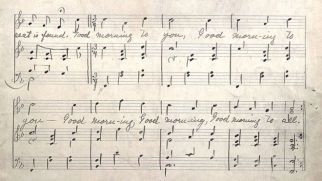
A portion of music manuscript for Happy Birthday’s predecessor, ‘Good Morning to All’ (courtesy of University of Louisville).
‘Happy Birthday To You’ is a staple of birthday parties around the world, but, until now, it couldn’t be sung in public or in TV shows and movies without paying a sizeable licence fee.
Now, though, a US federal judge has ruled that music publisher Warner/Chappell does not hold a valid copyright to the song.
Warner/Chappell has been collecting royalties on the song since acquiring the copyright in 1988 for some $25m (£16m). The publisher has reportedly been making around $2m a year from royalty payments whenever the song is used in a film, TV show, advertisement or any other kind of public performance. According to the Internet Movie Database, ‘Happy Birthday To You’ has been featured in nearly 150 films.
Judge George King has ruled that the original copyright (filed in 1935) was only granted for specific piano arrangements based on the original melody, and did not grant any rights to the lyrics.
The tune was composed in 1893 by two Kentucky sisters, Mildred and Patty Hill. They called their version ‘Good Morning To All’ which later evolved into the ‘Happy Birthday’ version which is now popular all over the world.
The case against Warner/Chappell was launched in 2013 by Rupa Marya and Robert Siegel, who are making a film about the history of the song. The music publisher wanted to charge $1,500 (£970) for the right to use the song in the film, but Marya and Siegel maintained that the song was in the public domain and should not be subject to copyright fees.
The ruling now puts the song in the public domain fifteen years before the copyright was due to expire in the US in 2030.
So here it is … royalty-free! And if it’s YOUR birthday today, happy birthday from all of us at The Hit Formula …
# # # #
![“HOW [NOT] TO WRITE A HIT SONG! - 101 COMMON MISTAKES TO AVOID IF YOU WANT SONGWRITING SUCCESS” is available from Amazon as a paperback and also as an eBook from Amazon’s Kindle Store, Apple's iTunes Store, Barnes and Noble's Nook store, and from KoboBooks.com.](https://thehitformula.com/wp-content/uploads/2013/05/how-not-to-write-a-hit-song-smashwords-cover-blog-widgit-188x282.jpg?w=116&h=168)
“How [Not] To Write A Hit Song! – 101 Common Mistakes To Avoid If You Want Songwriting Success” is available from Amazon as a US paperback, UK paperback and as an eBook from Amazon’s Kindle Store, Apple’s iTunes Store (Books/Arts & Entertainment/Music), Barnes & Noble’s Nook store, and from KoboBooks.
Read a FREE sample of the book HERE (USA), HERE (UK), HERE (Australia) and HERE (Canada).
 When David Bowie released his twenty-fourth studio album, The Next Day, in 2013, a journalist asked him to explain his thinking behind the new songs, each of which featured unusual, cryptic lyrics and surreal imagery.
Bowie responded by sending the journalist a list of 42 words which supposedly provided the framework for the critically-acclaimed album.
Here are those 42 words:
Effigies … Indulgences … Anarchist … Violence … Chthonicum … Intimidation … Vampyric … Pantheon … Succubus … Hostage … Transference … Identity … Mauer … Interface … Flitting … Isolation … Revenge … Osmosis … Crusade … Tyrant … Domination … Indifference … Miasma … Pressgang … Displaced … Flight … Resettlement … Funereal … Glide … Trace … Balkan … Burial … Reverse … Manipulate … Origin … Text … Traitor … Urban … Comeuppance …. Tragic … Nerve … Mystification.
Quite a confusing lyrical framework for an album that ended up including song titles such as: ‘The Stars (Are Out Tonight)’, ‘Love Is Lost’, ‘Where Are We Now?’, ‘Valentine’s Day’ and ‘The Next Day’.
Maybe the answer can be found in a 2008 interview with Bowie. In it he described how he often comes up with interesting lyric lines by employing the ‘cut-up’ writing technique used by postmodernist author William S. Burroughs in his controversial novel Naked Lunch.
‘Cut-up’ is a literary technique designed to add an element of chance to the creative process.
It involves taking a finished line of text and cutting it into pieces—usually with just one or two words on each piece. The resulting pieces are then rearranged to create a brand new text.
The cut-up concept can be traced back to the Dadaists of the 1920s, but it was developed further in the early 1950s by painter, writer and sound poet Brion Gysin—and then popularized in the late 1950s and early 1960s by Burroughs.
David Bowie explained: “I use it for igniting anything that may be in my imagination … You write down a paragraph or two describing several different subjects, creating a kind of ‘story ingredients’ list, I suppose, and then cut the sentences into four or five-word sections; mix ’em up and reconnect them.
“You can get some pretty interesting idea combinations like this,” he said. “You can use them as is or, if you have a craven need to not lose control, bounce off these ideas and write whole new sections.”
This technique is also said to have influenced Kurt Cobain’s songwriting. And Thom Yorke applied a similar method on Radiohead’s 2000 album Kid A. Yorke reportedly wrote single lines, put them into a hat, and drew them out at random while the band rehearsed the songs.
Here’s Bowie explaining his cut-up technique in the 1975 BBC TV documentary Cracked Actor …
So there you have it … If you want to get all Bowie-esque and create some unusual and intriguing lyrics, simply reach for your lyric notebook and a pair of scissors – and start cutting and pasting!
# # # #

WRITING SONGS IN THE STREAMING AGE – 40 MISTAKES TO AVOID IF YOU WANT TO GET MORE STREAMS is available from Amazon as a US paperback, a UK paperback, a Canada paperback, an Australia paperback, and across Europe.
It is also available as an eBook from Amazon’s Kindle store in the United States, Canada, the UK, Australia, and across Europe—as well as Apple Books, Barnes & Noble and Rakuten’s KoboBooks.
Read a FREE SAMPLE of the book HERE (USA)…HERE (UK)… HERE (CANADA)… and HERE (AUSTRALIA).
![“HOW [NOT] TO WRITE A HIT SONG! - 101 COMMON MISTAKES TO AVOID IF YOU WANT SONGWRITING SUCCESS” is available from Amazon as a paperback and also as an eBook from Amazon’s Kindle Store, Apple's iTunes Store, Barnes and Noble's Nook store, and from KoboBooks.com.](https://thehitformula.com/wp-content/uploads/2013/05/how-not-to-write-a-hit-song-smashwords-cover-blog-widgit-188x282.jpg?w=100) A 5-star rated book at Amazon, “How [Not] To Write A Hit Song! – 101 Common Mistakes To Avoid If You Want Songwriting Success” is available from Amazon as a US paperback, UK paperback and as an eBook from Amazon’s Kindle Store. It is also available from Apple’s iTunes Store (Books/Arts & Entertainment/Music), Barnes & Noble’s Nook store, and KoboBooks.
A 5-star rated book at Amazon, “How [Not] To Write A Hit Song! – 101 Common Mistakes To Avoid If You Want Songwriting Success” is available from Amazon as a US paperback, UK paperback and as an eBook from Amazon’s Kindle Store. It is also available from Apple’s iTunes Store (Books/Arts & Entertainment/Music), Barnes & Noble’s Nook store, and KoboBooks.
Read a FREE sample of the book HERE (USA) and HERE (UK), HERE (Australia) and HERE (Canada).
“How [Not] To Write Great Lyrics! – 40 Common Mistakes To Avoid When Writing Lyrics For Your Songs” is available from Amazon as a US paperback, UK paperback and as an eBook from Amazon’s Kindle Store. It is also available from Apple’s iTunes Store (Books/Arts & Entertainment/Music), Barnes & Noble’s Nook store, and KoboBooks.
Read a FREE sample of the book HERE (USA) and HERE (UK), HERE (Australia) and HERE (Canada).
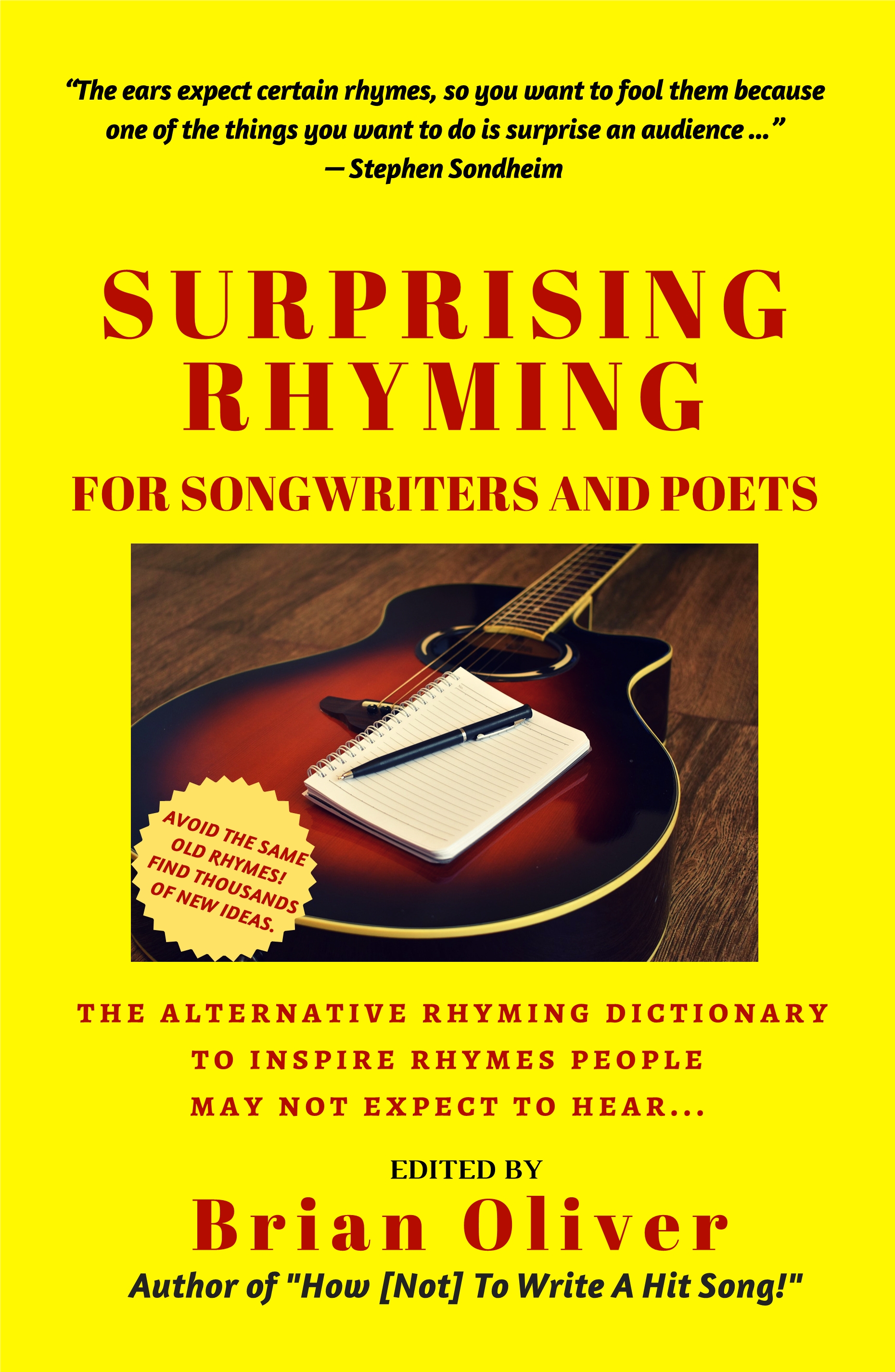
“SURPRISING RHYMING” – The Alternative Rhyming Dictionary for Songwriters and Poets – is available from Amazon as a US paperback, a UK paperback, and across Europe. It is also available as an eBook from Amazon’s Kindle store in the United States, the UK and Europe, as well as Apple’s iTunes Store, Barnes & Noble’s Nook Store and Rakuten’s KoboBooks.
Read a FREE sample of the book HERE (USA) … HERE (UK) … HERE (CANADA).
 “All I’ve ever wanted out of music is to look forward to waking up the next morning and seeing what’s going to come out of the guitar and what I’m going to figure out and what I’m going to create.”
—John Mayer (on the My Stupid Mouth fan forum)
# # # #
“How [Not] To Write A Hit Song! – 101 Common Mistakes To Avoid If You Want Songwriting Success” is available from Amazon as a US paperback, UK paperback and as an eBook from Amazon’s Kindle Store, Apple’s iTunes Store (Books/Arts & Entertainment/Music), Barnes & Noble’s Nook store, and from KoboBooks.
Read a FREE sample of the book HERE (USA), HERE (UK), HERE (Australia) and HERE (Canada).