 Many new songwriters often make the mistake of simply trying to mimic songs that have already enjoyed chart success, instead of trying to add distinctive elements of their own to create something fresh.
Pharrell Williams firmly believes in the importance of not just imitating what’s already happening: “I feel like when you copy, you blend in, and when you blend in, you get lost,” he recently told Collider.com.
“If someone asks me what inspires me, I always say ‘That which is missing’ because I don’t want to copy everything that’s already happening,” he said. “When I make music, I try to make something you’ve never heard before.”
For new writers, though, it is equally important to make sure that your songs are not TOO different—otherwise you could end up writing in a form that many listeners just can’t understand. You have to strike a balance.
This is because there are specific conventions that are consistently found in the chord progressions, melodies, lyrics, rhymes and construction of all hit songs. Over the past 50 years in particular, listeners have subconsciously come to expect to hear these elements in all new songs.
To be sure of finding receptive ears in the music industry (and amongst record buyers), your songs therefore need to sound familiar—but not similar.
Previously unheard songs have to be easy enough on the listener’s ear to be commercial and marketable (which, at the end of the day, is all that record companies and music publishers are interested in). But instead of simply copying stuff that is happening, focus on taking what is already out there to a new level—whilst being careful not to make too big a leap that could leave a huge gap between you and your audience.
When someone once asked the legendary trumpet player Clark Terry what steps he felt newcomers should take to achieve success, he famously replied: “Imitate, assimilate, and innovate”.
In other words, listen to what’s being played on the radio and on streaming services, analyze the latest trends, absorb the key elements of current hit songs and emulate them—but carve your own niche by innovating and adding something new of your own.
As Pharrell Williams says: “Try to find that which is missing”…
# # # #

WRITING SONGS IN THE STREAMING AGE – 40 MISTAKES TO AVOID IF YOU WANT TO GET MORE STREAMS is available from Amazon as a US paperback, a UK paperback, a Canada paperback, an Australia paperback, and across Europe.
It is also available as an eBook from Amazon’s Kindle store in the United States, Canada, the UK, Australia, and across Europe—as well as Apple Books, Barnes & Noble and Rakuten’s KoboBooks.
Read a FREE SAMPLE of the book HERE (USA)…HERE (UK)… HERE (CANADA)… and HERE (AUSTRALIA).
 “How [Not] To Write A Hit Song! – 101 Common Mistakes To Avoid If You Want Songwriting Success” is available from Amazon as a US paperback, UK paperback and as an eBook from Amazon’s Kindle Store, Apple’s iTunes Store (Books/Arts & Entertainment/Music) and Barnes & Noble’s Nook store.
Read a FREE sample of the book HERE (USA), HERE (UK), HERE (Australia) and HERE (Canada).
 British singer-songwriter Molly Smitten-Downes will represent the United Kingdom in the Grand Final of this year’s Eurovision Song Contest, with her self-penned song ‘Children of the Universe’.
The event will take place in Copenhagen on 10 May 2014.
‘Children of the Universe’ is described as “an anthemic, uplifting track specifically written with live performance in mind”.
Molly, aged 26, from Leicestershire, was discovered through BBC Radio’s BBC Introducing and was invited to compose and perform a song especially for the competition.
Molly has been singing and writing songs for over ten years and is well known within the UK live music scene. She was awarded Best Urban/Pop Act at Live and Unsigned in 2012, and in 2013 won ‘Best Song’ at the Best of British Unsigned Music Awards.
She has supported artists such as Jake Bugg, Tinie Tempah, Labrinth and Chase n Status.
“I’m so excited for everyone to hear ‘Children of The Universe’,” says Molly. “I’m so happy with it. To represent the United Kingdom in such a huge competition, not only as a singer and performer but as a songwriter is an unbelievable honour.”
Here’s a video showing Molly performing ‘Children of The Universe’ live…
# # # #
“How [Not] To Write A Hit Song! – 101 Common Mistakes To Avoid If You Want Songwriting Success” is available from Amazon as a US paperback, UK paperback and as an eBook from Amazon’s Kindle Store, Apple’s iTunes Store (Books/Arts & Entertainment/Music) and Barnes & Noble’s Nook store.
Read a FREE sample of the book HERE (USA), HERE (UK), HERE (Australia) and HERE (Canada).

When your mother is a famous poet in your home country of New Zealand, it’s not surprising that 17-year-old Lorde (real name Ella Yelich-O’Connor) started out writing stories at a very early age. And she firmly believes it’s her background in writing short fiction that has made her the successful singer-songwriter that she is today.
“I’ve never written poetry, but I’ve written short fiction for a long time, and that’s the thing that I read pretty much exclusively,” Grammy award winner Lorde recently explained to Vogue magazine.
“Short fiction appeals to me because of the necessity of conciseness—having to make something big and get it into a small space,” she said. “That’s what writing songs is about, but times 20. I like people who can build something great and huge with a very limited amount of time or space. It’s difficult to do.”
As Neil Diamond once observed: “Songs are life in 80 words or less.”
Lorde—whose debut album Pure Heroine gained her four Grammy nominations—started writing her own songs as a 13-year-old when she was first signed to Universal Music. She realized at an early age that there are things you can do in a song that you can’t do in a short story.
“With songs, you listen to the lyrics and you know that not all the words and not all the details and not all the exposition have been included—you kind of expect to take leaps of faith, ” she told Rookie magazine. “One sentence can illustrate an entire experience or concept in a song, which I think is really cool.
“Whereas three or four years ago I would write a passage and then I would kind of have to fight to wrench it into the form of a song. Now when I have an idea [for a short story] and I write it,” she said, “it comes out naturally in the form of a song.”
In most hit songs, each verse tends to move the song’s storyline forward like a new chapter in a book, introducing fresh information and images that captivate the listener. The lyrics in each verse should be mostly descriptive (describing people, places and events).
The chorus, meanwhile, is meant to really drive home the whole point of the song—for example, by frequently repeating the title line like a catchphrase. The chorus lyrics should be mainly emotional (delivering a strong emotional reaction to what has just been described in the verse).
As Sting once remarked: “You’ve got to tell the story in two verses, a chorus and a coda and that takes some skill.”
Lorde’s chart-topping debut single ‘Royals’ won her two Grammy Awards for ‘Song of the Year’ and ‘Best Pop Solo Performance’:
# # # #

“How [Not] to Write Songs in the Streaming Age – 40 Mistakes to Avoid If You Want to Get More Streams” is available from Amazon as a US paperback, a UK paperback, a Canada paperback, an Australia paperback, and across Europe.
It is also available as an eBook from Amazon’s Kindle store in the United States, the UK, Canada, Australia, and across Europe—as well as Apple Books, Barnes & Noble and Rakuten’s KoboBooks.
Read a FREE SAMPLE of the book HERE (USA)…HERE (UK)… HERE (CANADA)… and HERE (AUSTRALIA).
“How [Not] To Write A Hit Song! – 101 Common Mistakes To Avoid If You Want Songwriting Success” is available from Amazon as a paperback, or as an eBook from Amazon’s Kindle Store, Apple’s iTunes Store (Books/Arts & Entertainment/Music) and Barnes & Noble’s Nook store.
Read a FREE sample of the book HERE (USA), HERE (UK), HERE (Australia) and HERE (Canada).
“Through the connectivity of the internet, people are becoming so desensitized to all the tragedies and travesties [in the world], that we need to take audiences to a lighter place,” Grammy Award-winning Pharrell Williams told Collider.com in a recent interview.
“There’s a need to lift people up emotionally,” said Williams whose chart-topping song ‘Happy’ is featured in the animated comedy movie Despicable Me 2 and has been nominated for an Oscar. Williams will perform the song at this year’s 86th Academy Awards on Sunday 2 March 2014.
Williams added: “There’s something to be said for making music that is jovial. Songs for people who need a break. Songs to bring joy.”
By advocating a greater focus on ‘happy’ songs, Pharrell Williams is actually going against the tide of the last five decades.
In 2012, an academic study revealed that pop music has grown progressively more sad-sounding and emotionally ambiguous since the 1960s. The number of minor chord hits has doubled since 1965, the study found, and fewer hit songs are now being written in major chords.
Music psychologist Professor E Glenn Schellenberg and sociologist Professor Christian von Scheve analysed the tempo (beats per minute) and mode (major or minor) of more than 1,000 American Top 40 songs that charted between 1965 and 2012. Their study found that in the second half of the 1960s, about 85% of songs that reached the top of the charts were written in a major mode, but by the second half of the 2000s that figure had fallen to only 43.5%.
“Just as the lyrics of pop songs have become more self-referential and negative in recent decades, the music has also changed—it sounds sadder and emotionally more ambivalent,” Schellenberg and von Scheve stated in their study.
The researchers noted that unambiguously happy songs like ABBA’s ‘Waterloo’ sound “naive and slightly juvenile” to today’s ears. And whilst more recent songs in a similar style, such as Aqua’s ‘Barbie Girl’, can still enjoy huge commercial success, they’re usually seen as a guilty pleasure and savaged by critics.
Schellenberg and von Scheve suggested that emotional ambiguity in a song is a way for some acts to convey their seriousness and complexity.
But Pharrell Williams insists that songwriters and artists should not forget about the happier side of things. He recently told Stereogum.com: “This particular generation doesn’t think within the same boundaries as people did back in, say, the Nineties. They completely recognize their freedom to make any kind of music they want …
“I try to tap into that because I want to make people happy.”
And look, here’s Pharrell Williams trying to cheer us all up…
# # # #
“How [Not] To Write A Hit Song! – 101 Common Mistakes To Avoid If You Want Songwriting Success” is available from Amazon as a paperback, or as an eBook from Amazon’s Kindle Store, Apple’s iTunes Store (Books/Arts & Entertainment/Music) and Barnes & Noble’s Nook store.
Read a FREE sample of the book HERE (USA), HERE (UK), HERE (Australia) and HERE (Canada).
 Grammy award-winning US singer-songwriter John Mayer claims he isn’t worried about writing hits any more. He insists that he no longer obsesses about dominating the charts. He now believes songs should focus more on being meaningful rather than simply having a catchy melody.
“I’m not worried about pop hits; I’m not worried about sales or relevance,” he recently told TIME.com. “I only care about one thing: tell your story. Tell YOUR story. … Follow where the road takes you.”
However, when telling your own story it is important to make sure that your song is not too narrow and personal. Don’t be too insular. Ideally, the song should be written in a way that leaves the audience thinking the song is about them and their lives—not about you.
People don’t really want to hear about your problems. They might, however, want to listen if your songs are about experiences, hardships and situations that everyone can relate to—such as a broken love affair, a personal tragedy, or a song about concern for the environment.
As singer-songwriter Jackson Browne once remarked when describing his own approach to storytelling: “I’m not looking to describe something that’s only true of my own circumstances. It’s all about reaching inside to something that you have in common with many.”
By writing about something that everyone experiences in his or her own life, you can touch people’s emotions. If you can engage listeners’ minds and make them feel something, it’s the sign of a good song.
On the subject of writing good songs, John Mayer urges new writers not to worry too much about whether a song is good or bad when they are writing it. “Just write it,” he says. “The rule is: write bad songs, but write ’em. If you start writing bad songs, you start writing better songs, and then you start getting really good.
“If you try to get into the building on the twelfth floor, you’ll never make it. You have to get in the basement floor and work up from there.”
Take a look at this quirky lyric video for ‘Paper Doll’ from John Mayer’s sixth album Paradise Valley.
# # # #
“How [Not] To Write A Hit Song! – 101 Common Mistakes To Avoid If You Want Songwriting Success” is available from Amazon as a paperback, or as an eBook from Amazon’s Kindle Store, Apple’s iTunes Store (Books/Arts & Entertainment/Music), Barnes & Noble’s Nook store, and Rakuten’s KoboBooks.
Read a FREE sample of the book HERE (USA), HERE (UK), HERE (Australia) and HERE (Canada).
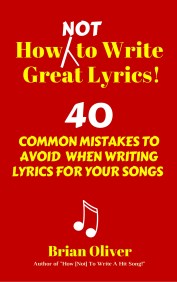
“How [Not] To Write Great Lyrics! – 40 Common Mistakes To Avoid When Writing Lyrics For Your Songs” is available from Amazon and Barnes & Noble as a US paperback, UK paperback and as an eBook from Amazon’s Kindle Store. It is also available from Apple’s iTunes Store (Books/Arts & Entertainment/Music), Barnes & Noble’s Nook store, and Rakuten’s KoboBooks.
Read a FREE sample of the book HERE (USA), HERE (UK), HERE (Australia) and HERE (Canada).
“SURPRISING RHYMING” – The Alternative Rhyming Dictionary for Songwriters and Poets – is available from Amazon as a US paperback, a UK paperback, and across Europe. It is also available as an eBook from Amazon’s Kindle store in the United States, the UK and Europe, as well as Apple’s iTunes Store, Barnes & Noble’s Nook Store and Rakuten’s KoboBooks.
Read a FREE sample of the book HERE (USA) … HERE (UK) … HERE (CANADA).
 Sam Smith, the hotly tipped British soul singer-songwriter, believes there is a gap in the market for songs about “unrequited love” instead of more common themes for love songs such as falling in love or breaking up.
Sam – who came top of the BBC’s ‘Sound Of 2014′ list and was nominated for the 2014 BRIT Critics’ Choice Award – recently told Emma Brown of Interview magazine: “I don’t think unrequited love is spoken about enough in music. I’ve been through it myself and I found it hard to find songs that were about that.”
He said he intends to focus on this kind of love song on his new album, In The Lonely Hour, which is due to be released in the spring.
“I’ve never been in love with someone who has loved me back,” he said. “So I wanted to write an album for people who have never been in love. I want to be a voice for lonely people.”
Sam explained that when he writes and records a song that lays out all of the raw emotion of everything he is going through, he often listens to the track at home when he’s feeling down. “And it somehow makes me feel better,” he said.
The great George Gershwin once described songwriting as “an emotional science” and there is actually a scientific reason why listening to sad songs can help to cheer us up.
According to a recent study by Japanese scientists, the reason we enjoy listening to sad music when we’ve had a negative experience is because it can actually evoke positive emotions in the brain.
In July 2013, researchers from Tokyo University of the Arts and the RIKEN Brain Science Institute in Japan discovered that melancholy tunes can stimulate romantic emotions as well as sad ones.
“Sad music might even help to alleviate negative emotion if a person is suffering from an unpleasant feeling caused by real life events,” explained Ai Kawakami from Tokyo University of the Arts.
He said: “Emotion experienced by music has no direct danger or harm unlike the emotion experienced in everyday life. Therefore, we can even enjoy unpleasant emotion such as sadness, possibly because the latter does not pose an actual threat to our safety. This could help people to deal with their negative emotions in daily life.”
Sam Smith performs an acoustic version of his song ‘Not In That Way’, recorded at Abbey Road Studios:
# # # #
“How [Not] To Write A Hit Song! – 101 Common Mistakes To Avoid If You Want Songwriting Success” is available from Amazon as a paperback, or as an eBook from Amazon’s Kindle Store, Apple’s iTunes Store (Books/Arts & Entertainment/Music) and Barnes & Noble’s Nook store.
Read a FREE sample of the book HERE (USA), HERE (UK), HERE (Australia) and HERE (Canada).
 Because great song titles, themes and lyric lines can come from anything and everything around you, it’s important to make sure you grab them right away in case you forget them, warns British rapper Tinie Tempah.
‘My thing is to constantly take notes on my smartphone,” says Tinie whose debut single ‘Pass Out’ entered the UK Singles Chart at Number One in February 2010. He famously began his hip-hop career as a schoolboy, composing songs in class and telling teachers his lyrics were poetry.
“Most of my lyrics are inspired by my everyday life so I’m swimming in sources of inspiration,” he says. “Even when I’m out having fun with my friends, I’m always using my phone to make notes for new songs.”
He adds: “When I change country, when I’ve got a long and difficult day, when I spend a 100 per cent fun weekend, I’m still writing. I collect lyrics.”
It is also important to keep a note of these odds and ends in one place—such as on your phone—so that you always know where to find them. Coming back to them at a later date—and looking at them from a fresh perspective—can often result in a spark of inspiration that helps you finish the song. Sometimes the best songs just need to gestate a little in your subconscious before all the pieces fit together.
Tinie Tempah says he stores his lyrics until he finds a piece of music that he likes, then he tries to fit the right words to the beat. “When I hear a beat that speaks to me, I have a browse in my phone and piece it all together,” he explains. “It’s kind of like a construction game.”
# # # #
“How [Not] To Write A Hit Song! – 101 Common Mistakes To Avoid If You Want Songwriting Success” is available from Amazon as a paperback, or as an eBook from Amazon’s Kindle Store, Apple’s iTunes Store (Books/Arts & Entertainment/Music) and Barnes & Noble’s Nook store.
Read a FREE sample of the book HERE (USA), HERE (UK), HERE (Australia) and HERE (Canada).
 “It’s no use just singing about being famous, or rhyming ‘crazy’ with ‘baby’ a million times over,” Lily Allen recently told Q magazine. “I want to write about things that are relevant to other people. And I like to be frank whether it’s about sex or politics or feminism.”
Lily’s comments are especially pertinent to new songwriters. A common mistake among many aspiring writers is their use of over-elaborate imagery and ‘poetic’ lyrics in an attempt to show how clever and creative they can be. Far from being impressed, though, music publishers and A&R reps may view too much flowery language as a sign of inexperience.
Trying too hard to be ‘different’ and artistic can often result in lyrics that simply sound pretentious and self-indulgent. If your lyrics don’t come across as genuine, listeners may find it hard to connect with your song.
Lily Allen frequently achieves a personal connection by writing as if she’s having a one-on-one conversation with the listener, often making lines sound like they could be spoken naturally.
If a new song is likely to have any chance of success, it must be able to touch listeners on an emotional level and make them feel something.
That means a song needs to be about something that everyone is familiar with. And the lyrics should be honest, believable and heartfelt so that people can easily relate to them.
# # # #
“How [Not] To Write A Hit Song! – 101 Common Mistakes To Avoid If You Want Songwriting Success” is available from Amazon as a US paperback, UK paperback and as an eBook from Amazon’s Kindle Store, Apple’s iTunes Store (Books/Arts & Entertainment/Music), Barnes & Noble’s Nook store, and from KoboBooks.
Read a FREE sample of the book HERE (USA) and HERE (UK),
 We constantly hear about young singer-songwriters such as Taylor Swift and Katy Perry writing emotionally wrenching songs about their past loves and broken relationships. And other young writers find new ways of expressing the emotions associated with issues they’re experiencing for the first time—such as finding yourself, friendships, coming of age, fitting in, and growing up.
But what do songwriters turn to for inspiration when they get older?
Janis Ian was only 22 when she wrote her classic song ‘At Seventeen’—a groundbreaking, poignant commentary on adolescent cruelty and teenage angst. Would she be able to write that song now, 40 years later?
The answer, according to award-winning Nashville songwriter Brett James, is to learn how to think like a 15-year-old again.
In an interview with Viacom’s country music TV channel CMT, 45-year-old James explained that songwriters sometimes need to re-discover the adolescent inside them in order to come up with a great idea that hasn’t been written about before.
“You always want to keep that freshness, so you have to feel like a 15-year-old kid who has never written a song—sometimes it’s important to sit down with that attitude,” said James whose number one hits include Carrie Underwood’s Grammy Award-winning ‘Jesus, Take the Wheel’, ‘Who I Am’ by Jessica Andrews and Martina McBride’s ‘Blessed’.
James told CMT: “Sometimes we rehash and put twists on ideas. But there have been a lot of songs written in the world, so it’s tough to find the one that no one’s thought of yet. When you can write something truly original, the world takes notice.”
To achieve major success, songs need to be about issues and emotions that everyone is familiar with—and the lyrics should be honest, believable and heartfelt so that people can easily relate to them. If your lyrics don’t come across as genuine and relevant, listeners may find it hard to connect with your song.
Do you ever try to find inspiration, as Brett James suggests, by taking yourself back to when you were first starting out and every new chord, every new chord progression, every new song title, and every new way of rhyming a lyric was a wondrous discovery?
# # # #
“How [Not] To Write A Hit Song! – 101 Common Mistakes To Avoid If You Want Songwriting Success” is available from Amazon as a US paperback, UK paperback and as an eBook from Amazon’s Kindle Store, Apple’s iTunes Store (Books/Arts & Entertainment/Music), Barnes & Noble’s Nook store, and from KoboBooks.
Read a FREE sample of the book HERE (USA), HERE (UK), HERE (Australia) and HERE (Canada).
 Most experienced songwriters recognize that if a song is to become a great song, it must be able to reach out and touch listeners and stimulate an emotional response within them. It must make them feel something.
Katy Perry calls this her ‘goose bump test’.
“There’s this test that I do after a song’s complete and you’ve tracked some vocals,” Katy recently told MTV. “If every time you hear it, it gives you goose bumps then it’s hitting an emotional chord inside of you that’s really important.”
Katy cites her latest single ‘Unconditionally’ as an example of this. She felt inspired to sit down and write the song shortly after travelling to Madagascar with UNICEF. Touched by the unconditional love that the children she met had for each other – despite their poverty – she decided to pen some lyrics about what it means to care for someone in the purest form.
Katy says that ‘Unconditionally’ went on to pass her ‘goose bump test’ and it is her favourite song on her latest album Prism.
Try giving your own songs the ‘goose bump test’ with the people closest to you, someone who will give you an honest opinion. If the song doesn’t genuinely move them in its rawest, stripped-down form—one vocal and a single guitar or piano—then the song has failed.
Don’t fool yourself into thinking a magical transformation will take place in the studio if you decide to spend money on making a demo of the song. Trying to create an emotional connection with the aid of lots of production frills won’t fool listeners (or music publishers or A&R execs!). They always look to the song inside the recording.
As Neil Sedaka once observed: “The most challenging task for a songwriter is to write a simple tune but still bring an emotional feeling to it … No frills. No production gimmicks.”
# # # #
“How [Not] To Write A Hit Song! – 101 Common Mistakes To Avoid If You Want Songwriting Success” is available from Amazon as a paperback, or as an eBook from Amazon’s Kindle Store, Apple’s iTunes Store (Books/Arts & Entertainment/Music) and Barnes & Noble’s Nook store.
Read a FREE sample of the book HERE (USA), HERE (UK), HERE (Australia) and HERE (Canada).
# # # #



 SONGWRITING: THE HIT FORMULA