MasterClass, the streaming platform where anyone can learn from the world’s best across a wide range of subjects, has announced that John Legend will teach a class on songwriting.
In his class, Legend will break down his songwriting process from start to finish, giving members a framework for finding their own voice and writing with purpose. Legend will also give members a first-hand look into the creation of his song ‘Free’ which he first performed at the 64th Annual Grammy Awards in April 2022.
Legend will show how to capture experiences and convey feelings through music. Using his hit songs ‘All of Me’, ‘Again’ and ‘Dope as case studies, he will explain how he uses ‘mumble’ tracks to write melodies and how he structures songs to tell a story.
Legend will help new writers to find inspiration in the world around them and turn their personal experiences into unique songs.
He will also walk members through the importance of being a strong collaborator, as well as how to blend musical genres and record background vocals. He’ll also provide tips for performing live.
“Songs are core to who we are and are such an important part of humanity,” Legend said. “My class will give you the tools to find your voice, figure out who you are and establish yourself with longevity so you can make a real impact through music.”
The class is available now exclusively on MasterClass, where subscribers get unlimited access to all 150+ instructors with an annual membership.
Here’s the trailer for John Legend’s MasterClass course:
It is also available as an eBook from Amazon’s Kindle store in the United States, the UK, Canada, Australia, and across Europe—as well as Apple Books, Barnes & Noble and Rakuten’s KoboBooks.
US performing rights organization Broadcast Music, Inc. (BMI) has announced that the BMI Foundation’s annual Nashville Songwriting Scholarship will be revised and renamed The Dolly Parton Songwriters Award in honor of the legendary artist.
The new program will also establish The Dolly Parton Music Fund which will underwrite the annual awards to emerging songwriters as well as initiatives to provide or supplement music programs in public schools, ensuring a new generation of music creators, and a well-rounded education for all.
The awards can be used as a career grant for study, instrument purchase, recording costs, or other professional expenses and are not restricted to tuition costs. Founding endowments include a lead gift from Sony Music Publishing’s Rusty Gaston as well as a contribution from country superstar Luke Combs, who donated proceeds from the recent BMI Parking Lot Party, celebrating his nine #1 hit songs.
Dolly Parton said: “I know how personal and important songwriting is to those that have the talent, and to all the others that enjoy those that have it. I’m proud to be part of a program that will help support songwriting in any way possible. I have been with BMI since I published my first song as a child, so of course I’m very proud and honored to have a BMI Songwriters Award made in my honor.”
The Dolly Parton Songwriters Award is an annual, nationwide competition open to aspiring songwriters. The award was established in 2015 as the Nashville Songwriting Scholarship by BMI to celebrate the company’s 75th Anniversary year.
Clay Bradley, BMI Foundation Board Member and BMI’s VP, Creative, said: “The Dolly Parton Music Fund will support the work of the BMI Foundation for years to come and will make a meaningful difference in the lives of our nation’s emerging songwriters. We are excited to be working with Dolly Parton on this program, not only honoring her legacy as a songwriter, but her unwavering commitment to fostering new talent, music education, and music appreciation.”
The revised program offers $20,000 for up to two of the best original song entries in any of the following genres: Americana, blues, bluegrass, contemporary Christian, country, folk, and roots. The inaugural award will be presented in Spring 2023 with applications opening in October.
John Legend believes gaining success as a songwriter is as much about working hard as it is talent.
“It sounds obvious, but there’s this mistaken belief that everything is about talent, but talent has to be cultivated and developed,” he once told Q magazine. “If it’s not nurtured, pushed and challenged it’s not going to happen.”
Legend says he’s proud of the fact that he started work on his career when he was little more than a toddler and insists he will never apologise for being demanding. “I was four and I begged my mom to get me piano lessons,” he told Q. “I was a precocious little kid. There was a lot of music in our house so I think me wanting to play was me trying to be a part of what was going on. It was a chance to perform.”
With his music inspired by the classic soul and R&B music he grew up listening to, Legend says his songwriting process is “almost the exact opposite” of how most other writers work. He believes the music should drive the lyrics.
“Some people start from a poetry base,” he says. “They’ll write a bunch of lyrics, then try to put them to music. I try to develop a compelling musical idea and make the words fit into it.”
He explains: “I usually start playing a melody and find the chords I like. Then I start singing something to it to see what works.
“I usually write the chorus first because that helps guide me into where I want the verses to go. Then I start fooling around with chord progressions for the verse.”
Most established songwriters would agree with John Legend that hard work is the key to success. The initial spark that ignites a song idea is a gift. From then on, it’s all about putting in the hours to get it right. And it calls for an exceptional level of self-motivation and self-belief, as well as talent.
The truly great songwriters just make it look easy. In reality, though, they have to put in hundreds of hours of hard work—making many mistakes along the way—in order to hone their talent and achieve their greatness.
Diane Warren, one of the most successful female songwriters of all time, says she spent 20 years writing six days a week, 10-12 hours a day before she felt she could finally take the occasional weekend off!
# # # #
“How [Not] to Write Songs in the Streaming Age – 40 Mistakes to Avoid If You Want to Get More Streams” is available from Amazon as a US paperback, a UK paperback, a Canada paperback, an Australia paperback, and across Europe. It is also available as an eBook from Amazon’s Kindle store in the United States, the UK, Canada, Australia, and across Europe—as well as Apple Books, Barnes & Noble and Rakuten’s KoboBooks.
“SURPRISING RHYMING” – The Alternative Rhyming Dictionary for Songwriters and Poets – is available from Amazon as a US paperback, a UK paperback, and across Europe. It is also available as an eBook from Amazon’s Kindle store in the United States, the UK and Europe, as well as Apple’s iTunes Book Store, Barnes & Noble’s Nook Store and Rakuten’s KoboBooks.
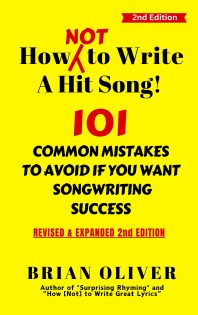
A 5-star rated book at Amazon, “How [Not] To Write A Hit Song! – 101 Common Mistakes To Avoid If You Want Songwriting Success” is available from Amazon as a US paperback, a UK paperback and as an eBook from Amazon’s Kindle Store. It is also available from Apple’s iTunes Book Store, Barnes & Noble’s Nook store, and Rakuten’s KoboBooks.
“How [Not] To Write Great Lyrics! – 40 Common Mistakes To Avoid When Writing Lyrics For Your Songs” is available from Amazon and Barnes & Noble as a US paperback, UK paperback and as an eBook from Amazon’s Kindle Store. It is also available from Apple’s iTunes Book Store, Barnes & Noble’s Nook store, and Rakuten’s KoboBooks.
“So many songs are now written by committee … Bruno Mars’ “That’s What I Like”, which won Song of the Year at this year’s Grammys, was credited to eight writers.
“I don’t understand how that works because, for me, a song starts with a melody combined with chords. I arrange the song with bass and drums after the song is finished, not the other way around.
“If I start with the drums and the bass and then add some chords, randomly, and then try to write a melody … I don’t know how that works. I don’t get it.
“What that lacks, I think, is a ‘sender’. If someone likes my music, that’s me; it’s me sending it to you. If there are seven or eight people behind it, are they all honest? Do they all mean it?”
“SURPRISING RHYMING” – The Alternative Rhyming Dictionary for Songwriters and Poets – is available from Amazon as a US paperback, a UK paperback, and across Europe. It is also available as an eBook from Amazon’s Kindle store in the United States, the UK and Europe, as well as Apple’s iTunes Book Store, Barnes & Noble’s Nook Store and Rakuten’s KoboBooks.
A 5-star rated book at Amazon, “How [Not] To Write A Hit Song! – 101 Common Mistakes To Avoid If You Want Songwriting Success” is available from Amazon as a US paperback, a UK paperback and as an eBook from Amazon’s Kindle Store. It is also available from Apple’s iTunes Book Store, Barnes & Noble’s Nook store, and Rakuten’s KoboBooks.
“How [Not] To Write Great Lyrics! – 40 Common Mistakes To Avoid When Writing Lyrics For Your Songs” is available from Amazon and Barnes & Noble as a US paperback, UK paperback and as an eBook from Amazon’s Kindle Store. It is also available from Apple’s iTunes Book Store, Barnes & Noble’s Nook store, and Rakuten’s KoboBooks.
When David Bowie released his twenty-fourth studio album, The Next Day, in 2013, a journalist asked him to explain his thinking behind the new songs, each of which featured unusual, cryptic lyrics and surreal imagery.
Bowie responded by sending the journalist a list of 42 words which supposedly provided the framework for the critically-acclaimed album. Here are those 42 words:
Quite a confusing lyrical framework for an album that ended up including song titles such as: ‘The Stars (Are Out Tonight)’, ‘Love Is Lost’, ‘Where Are We Now?’, ‘Valentine’s Day’ and ‘The Next Day’.
Maybe the answer can be found in a 2008 interview with Bowie. In it he described how he often came up with interesting lyric lines by employing the ‘cut-up’ writing technique used by postmodernist author William S. Burroughs in his controversial novel Naked Lunch.
‘Cut-up’ is a literary technique designed to add an element of chance to the creative process. It involves taking a finished line of text and cutting it into pieces—usually with just one or two words on each piece. The resulting pieces are then rearranged to create a brand new text.
The cut-up concept can be traced back to the Dadaists of the 1920s, but it was developed further in the early 1950s by painter, writer and sound poet Brion Gysin—and then popularized in the late 1950s and early 1960s by Burroughs.
David Bowie explained: “I used it for igniting anything that may have been in my imagination … You write down a paragraph or two describing several different subjects, creating a kind of ‘story ingredients’ list, I suppose, and then cut the sentences into four or five-word sections, then mix them up and reconnect them.
“You can get some pretty interesting idea combinations,” he said. “You can use them as is or, if you have a craven need to not lose control, bounce off these ideas and write whole new sections.”
The ‘cut-up’ technique is also said to have influenced Kurt Cobain’s songwriting. And Thom Yorke applied a similar method on Radiohead’s 2000 album Kid A. Yorke reportedly wrote single lines, put them into a hat, and drew them out at random while the band rehearsed the songs.
Here’s Bowie explaining his cut-up technique in the 1975 BBC TV documentary Cracked Actor …
In the early 1990s, Bowie developed a more advanced version of his ‘cut-up’ technique when he teamed up with Gracenote co-founder Ty Roberts to create the Verbasizer—a custom program for Apple’s Mac which is now regarded as an early form of AI-based songwriting.
The Verbasizer randomized portions of Bowie’s inputted text sentences to create new ones with new meanings and moods. It would cut up and reassemble Bowie’s words electronically, much like he had done with paper, scissors and glue back in the 1970s. Bowie made use of the Verbasizer to create the lyrics and liner notes for his 1995 album Outside.
“What you end up with is a real kaleidoscope of meanings and topic and nouns and verbs all sort of slamming into each other,” Bowie explained in this 1997 documentary about the Verbasizer …
It is also available as an eBook from Amazon’s Kindle store in the United States, the UK, Canada, Australia, and across Europe—as well as Apple Books, Barnes & Noble and Rakuten’s KoboBooks.
A 5-star rated book at Amazon, “How [Not] To Write A Hit Song! – 101 Common Mistakes To Avoid If You Want Songwriting Success” is available from Amazon as a US paperback, UK paperback and as an eBook from Amazon’s Kindle Store. It is also available from Apple’s iTunes Store (Books/Arts & Entertainment/Music), Barnes & Noble’s Nook store, and Rakuten’s KoboBooks.
“How [Not] To Write Great Lyrics! – 40 Common Mistakes To Avoid When Writing Lyrics For Your Songs” is available from Amazon as a US paperback, UK paperback and as an eBook from Amazon’s Kindle Store. It is also available from Apple’s iTunes Store (Books/Arts & Entertainment/Music), Barnes & Noble’s Nook store, and Rakuten’s KoboBooks.
“SURPRISING RHYMING” – The Alternative Rhyming Dictionary for Songwriters and Poets – is available from Amazon as a US paperback, a UK paperback, and across Europe. It is also available as an eBook from Amazon’s Kindle store in the United States, the UK and Europe, and from Apple Books worldwide.
As experienced songwriters know, you only have a limited amount of time in which to grab a listener’s attention and create a lasting impression on them. If your song structure and lyrics are too complicated and difficult to understand, listeners may find it hard to grasp what you’re trying to communicate to them … and they could soon lose interest in the song.
The Foo Fighters’ frontman Dave Grohl compares this challenge to trying to solve a Rubik’s Cube. “You have to try to find a melody and lyric that will braid together and create four minutes of memory that you’ll have for the rest of your life,” he explained in a recent Billboard Chart Beatpodcast.
“To me, the challenge is always trying to craft a song that is simple in a way that people will connect to it emotionally,” he said. “Even just a melody … that’s a funny thing. A lyric is one thing, but there’s something that a melody can do … just the sound of a minor scale, or a major scale rising in a chorus. The notes will twist your heart.”
As Dave Grohl acknowledges, for a song to become a great song it must be able to reach out and touch listeners and stimulate an emotional response within them. It should make them feel something and take them on an emotional journey.
The great George Gershwin once described songwriting as “an emotional science”, and scientific studies have shown that a wide range of notes can imply joy or uneasiness, while a narrower range of notes can suggest tranquillity, sadness or triumph.
Major chords often convey happiness or joy, while minor chords are associated with sadness. Using a mix of minor chords and major chords can add extra depth and colour to a song. But chord progressions should not be so complicated that they don’t flow properly and end up wandering aimlessly.
And remember, a song should contain only one story, or one message, told from a single point of view. Lyrically, you can avoid confusing the listener by using the viewpoint character’s thoughts and perceptions to drive the song.
New songwriters, who are still developing their craft, often fall into the trap of believing that every line of their song has to be clever or tricky in order to make an impression on the listener. What they should really be focusing on is making sure that the structure of their song is clear, simple and easy to follow. This will make it easier for people to feel an emotional connection with the song.
As Dave Grohl suggests, even within a simple song form the use of certain chord progressions and recurring sequences of notes can have an emotional effect on the listener. The Foo Fighters’ classic song “Times Like These” is a great example of this …
It is also available as an eBook from Amazon’s Kindle store in the United States, the UK, Canada, Australia, and across Europe—as well as Apple Books, Barnes & Noble and Rakuten’s KoboBooks.
“SURPRISING RHYMING” – The Alternative Rhyming Dictionary for Songwriters and Poets – is available from Amazon as a US paperback, a UK paperback, and across Europe. It is also available as an eBook from Amazon’s Kindle store in the United States, the UK and Europe, as well as Apple’s iTunes Book Store, Barnes & Noble’s Nook Store and Rakuten’s KoboBooks.
A 5-star rated book at Amazon, “How [Not] To Write A Hit Song! – 101 Common Mistakes To Avoid If You Want Songwriting Success” is available from Amazon as a US paperback, a UK paperback and as an eBook from Amazon’s Kindle Store. It is also available from Apple’s iTunes Book Store, Barnes & Noble’s Nook store, and Rakuten’s KoboBooks.
“How [Not] To Write Great Lyrics! – 40 Common Mistakes To Avoid When Writing Lyrics For Your Songs” is available from Amazon and Barnes & Noble as a US paperback, UK paperback and as an eBook from Amazon’s Kindle Store. It is also available from Apple’s iTunes Book Store, Barnes & Noble’s Nook store, and Rakuten’s KoboBooks.
From Paul Weller’s emergence as a songwriting force with the power punk of The Jam in the 1970s to the soul sounds of The Style Council in the 1980s—followed by many diverse solo albums since—he has continually evolved his approach to songwriting. Weller warns that writers who don’t seek new challenges risk simply repeating themselves and could start to bore their listeners as a result.
“No matter what age you are, there’s always something else to learn,” he told Another Man magazine in a recent interview. “I just want to keep finding new things—new ground. You have to keep moving forward.”
Weller believes it’s essential for songwriters to set themselves a goal with each new song. “I might have an idea, however vague it is at the time, of where I want to try and take the music,” he told Another Man. “Sometimes you get there, sometimes you don’t – and sometimes you end up with something that isn’t what you set out to do, but is something else again, and something that surprises you because you didn’t realise you could go there.”
He added: “It’s a question of setting yourself a certain amount of challenges. Otherwise it’s too easy to get caught in a cycle of doing the same things over and over again.”
When new writers achieve an important breakthrough and discover a songwriting ‘formula’ that really works for them, they are naturally tempted to stick to it on every song. The innovation could be the result of a particular chord progression—or the use of a specific climactic chord change or a musical phrase—and it helps them create a new kind of song that evokes the best response they’ve ever had from listeners.
While they may want to take advantage of this winning ‘formula’ to help them establish their own distinctive sound and style, they should be careful not to end up writing songs that are all built around the same few notes, chords and keys. Each new song may sound great on its own, but there’s a danger that a writer could end up with a collection of songs that all sound alike—especially if he or she puts them together on the same demo submission, or on a showcase album, or on their own website and YouTube channel.
Paul Weller believes that being open to collaboration with other people is one way of constantly exploring new things and “expanding your own world”. For example, on his latest solo album, True Meanings (his 14th studio album), Weller has teamed up with other talent such as Lucy Rose, Conor O’Brien from Villagers, and Erland Cooper.
It has resulted in yet another new ‘sound’ for Paul Weller, as this beautiful track, ‘Gravity,’ demonstrates …
“SURPRISING RHYMING” – The Alternative Rhyming Dictionary for Songwriters and Poets – is available from Amazon as a US paperback, a UK paperback, and across Europe. It is also available as an eBook from Amazon’s Kindle store in the United States, the UK and Europe, as well as Apple’s iTunes Book Store, Barnes & Noble’s Nook Store and Rakuten’s KoboBooks.
A 5-star rated book at Amazon, “How [Not] To Write A Hit Song! – 101 Common Mistakes To Avoid If You Want Songwriting Success” is available from Amazon as a US paperback, a UK paperback and as an eBook from Amazon’s Kindle Store. It is also available from Apple’s iTunes Book Store, Barnes & Noble’s Nook store, and Rakuten’s KoboBooks.
“How [Not] To Write Great Lyrics! – 40 Common Mistakes To Avoid When Writing Lyrics For Your Songs” is available from Amazon and Barnes & Noble as a US paperback, UK paperback and as an eBook from Amazon’s Kindle Store. It is also available from Apple’s iTunes Book Store, Barnes & Noble’s Nook store, and Rakuten’s KoboBooks.
It is also available as an eBook from Amazon’s Kindle store in the United States, the UK, Canada, Australia, and across Europe—as well as Apple Books, Barnes & Noble and Rakuten’s KoboBooks.
“SURPRISING RHYMING” – The Alternative Rhyming Dictionary for Songwriters and Poets – is available from Amazon as a US paperback, a UK paperback, and across Europe. It is also available as an eBook from Amazon’s Kindle store in the United States, the UK and Europe, as well as Apple’s iTunes Book Store, Barnes & Noble’s Nook Store and Rakuten’s KoboBooks.
A 5-star rated book at Amazon, “How [Not] To Write A Hit Song! – 101 Common Mistakes To Avoid If You Want Songwriting Success” is available from Amazon as a US paperback, a UK paperback and as an eBook from Amazon’s Kindle Store. It is also available from Apple’s iTunes Book Store, Barnes & Noble’s Nook store, and KoboBooks.
“How [Not] To Write Great Lyrics! – 40 Common Mistakes To Avoid When Writing Lyrics For Your Songs” is available from Amazon and Barnes & Noble as a US paperback, UK paperback and as an eBook from Amazon’s Kindle Store. It is also available from Apple’s iTunes Book Store, Barnes & Noble’s Nook store, and KoboBooks.
“I don’t think Max Martin is human,” says record label boss and reality TV judge Simon Cowell. “Nobody human can do everything he’s done over the years. He has helped to make and define a sound and that’s what makes him a genius.”
With record sales in the hundreds of millions, Max Martin is acknowledged as one of the most successful songwriters and producers of the 21st century. His huge back catalogue includes massive hit songs for Adele, Britney Spears, Katy Perry, Justin Timberlake, The Backstreet Boys, Justin Bieber, Robyn, The Weeknd, and many more …
He has had writing credits on 22 songs that topped the Billboard Hot 100 (that’s about 6% of all US Number One songs since 1991), which means he’s the third most successful songwriter in US chart history behind only Paul McCartney and John Lennon.
In this rare Masterclass interview with Swedish journalist Jan Gradvall, the usually publicity-shy Max Martin discusses his phenomenally successful songwriting process … and reveals the special ingredients that make a great pop song.
It is also available as an eBook from Amazon’s Kindle store in the United States, the UK, Canada, Australia, and across Europe—as well as Apple Books, Barnes & Noble and Rakuten’s KoboBooks.
“SURPRISING RHYMING” – The Alternative Rhyming Dictionary for Songwriters and Poets – is available from Amazon as a US paperback, a UK paperback, and across Europe. It is also available as an eBook from Amazon’s Kindle store in the United States, the UK and Europe, as well as Apple’s iTunes Store, Barnes & Noble’s Nook Store and Rakuten’s KoboBooks.
A 5-star rated book at Amazon, “How [Not] To Write A Hit Song! – 101 Common Mistakes To Avoid If You Want Songwriting Success” is available from Amazon as a US paperback, a UK paperback and as an eBook from Amazon’s Kindle Store. It is also available from Apple’s iTunes Store, Barnes & Noble’s Nook store, and KoboBooks.
“How [Not] To Write Great Lyrics! – 40 Common Mistakes To Avoid When Writing Lyrics For Your Songs” is available from Amazon and Barnes & Noble as a US paperback, UK paperback and as an eBook from Amazon’s Kindle Store. It is also available from Apple’s iTunes Store, Barnes & Noble’s Nook store, and KoboBooks.
In a recent live Q&A session at the Liverpool Institute for Performing Arts (LIPA), Paul McCartney told Pulp frontman Jarvis Cocker that, in the early days of The Beatles, he and John Lennon had to write catchy songs because it was the only way they could remember them. Portable tape recorders hadn’t been invented yet.
“We had to write songs you could remember easily,” McCartney said. “I think that turned out to be a good thing.
“John and I would have a writing session, go away and have an evening out, and in the middle of the evening we’d think, ‘What was that thing we wrote? Oh my God we’ve forgotten!’ But it would always come back to us in the morning.
“We said if we can’t remember it, how do we expect other people to? So, we were writing stuff that was memorable … and I think it still is.”
# # # #
“SURPRISING RHYMING” – The Alternative Rhyming Dictionary for Songwriters and Poets – is available from Amazon as a US paperback, a UK paperback, and also across Europe. It is also available as a Kindle ebook in the United States and in the UK and Europe. Read more about the book HERE (USA) … HERE (UK) … HERE (CANADA).
A 5-star rated book at Amazon, “How [Not] To Write A Hit Song! – 101 Common Mistakes To Avoid If You Want Songwriting Success” is available from Amazon as a US paperback, a UK paperback and as an eBook from Amazon’s Kindle Store. It is also available from Apple’s iTunes Store (Books/Arts & Entertainment/Music), Barnes & Noble’s Nook store, and KoboBooks.
“How [Not] To Write Great Lyrics! – 40 Common Mistakes To Avoid When Writing Lyrics For Your Songs” is available from Amazon and Barnes & Noble as a US paperback, UK paperback and as an eBook from Amazon’s Kindle Store. It is also available from Apple’s iTunes Store (Books/Arts & Entertainment/Music), Barnes & Noble’s Nook store, and KoboBooks.
“HOW [NOT] TO WRITE SONGS IN THE STREAMING AGE – 40 MISTAKES TO AVOID IF YOU WANT TO GET MORE STREAMS” - This book shows how the dominance of music streaming is having a profound impact on songwriting and the structure of songs. Songs that connect in the streaming world are no longer the same as songs that work on traditional media, like radio. Successful streaming now requires a different type of song. This means songwriters who want more plays on streaming platforms need to rethink their songwriting approach in order to meet the specific needs of streaming audiences. This book aims to provide a better understanding of the new building blocks of song structure in the streaming age. It examines essential elements found in the construction, melodies and lyrics of the biggest streaming hits – and highlights the most common errors made when these key components are built into a song. To help new songwriters avoid such mistakes in their own songs, the book provides 40 insightful tips and a comprehensive Checklist for creating more streaming-friendly songs. The book is now available from Amazon as a paperback and eBook, and also from leading eBook retailers like Apple Books, Kobo and Barnes & Noble.
‘HOW (NOT) TO WRITE A HIT SONG! – 101 COMMON MISTAKES TO AVOID IF YOU WANT SONGWRITING SUCCESS’
With a 5-star rating at Amazon, this revised and expanded Second Edition of “How [Not] To Write A Hit Song!” takes a close look at the essential elements consistently found in the structure, melodies, and lyrics of hit songs today.
The music industry has been going through major changes in recent years, largely driven by the dominance of the music streaming companies. Streaming is now impacting the way songs are being written and recorded. And it’s changing the whole methodology of songwriting. This expanded Second Edition examines how these changes are affecting the key elements found in all hit songs. The book highlights the most common errors made when these essential components are built into a song—so that new writers can try to avoid such mistakes in their own songs.
Most writers have had to endure the disappointment of having their songs rejected, and ended up asking: “Could I have done more to make my songs better?”. “How [Not] To Write A Hit Song!” aims to help writers recognize weaknesses in their songs, so they can re-work them, make them stronger, and hopefully achieve the breakthrough they’re striving for.
The book includes a detailed checklist of 101 common mistakes that writers can measure their own songs against.
“HOW (NOT) TO WRITE GREAT LYRICS! 40 COMMON MISTAKES TO AVOID WHEN WRITING LYRICS FOR YOUR SONGS”
The 40 most common lyric writing mistakes are exposed in this new book by experienced music publisher and music consultant Brian Oliver.
Written in an easy, non-technical style, the book identifies the most frequent causes of lyric writing problems and aims to help aspiring songwriters steer clear of the many traps that they can easily fall into when writing lyrics for their songs.
“How [Not] To Write Great Lyrics!” gives new writers a wide range of valuable advice – from how to prevent common errors in the basic construction of their song lyrics … through to the perils of making bad choices when it comes to titles, opening lines, lyrical hooks, verb selection, clichés, rhyming patterns, and many other issues.
The book includes a comprehensive checklist of more than 100 potential hazards that writers can measure their own lyrics against.
“SURPRISING RHYMING FOR SONGWRITERS AND POETS -THE ALTERNATIVE RHYMING DICTIONARY”
With more new songs being written than ever before, songwriters are finding it harder to sound original and craft rhymes that have not already been used. “SURPRISING RHYMING” is a new kind of rhyming dictionary that aims to make it easier for writers to avoid clichés and create rhymes people may not have heard before.
Based on an in-depth study of the ingenious rhymes used by some of the world’s greatest songwriters and lyricists, this book offers an astonishing array of thousands of alternative rhyme options. It contains rhyme types much broader than those found in traditional rhyming dictionaries which tend to stick to ‘perfect’ rhymes. Instead, it focuses on ‘imperfect’ rhymes that are less predictable than ‘pure’ rhymes—and are therefore more likely to surprise an audience. The book also includes many new words that have been added to standard dictionaries in recent years.
With 624 pages, the book is laid out clearly to make it quick and easy to find the perfect word to achieve a memorable rhyme. There are separate sections for one-, two- and three-syllable rhymes, along with many useful tips on rhyming.
“SURPRISING RHYMING” is available from Amazon as a paperback and an eBook. It’s also available as an eBook from Apple’s iTunes Store, Barnes & Noble and Rakuten’s KoboBooks.



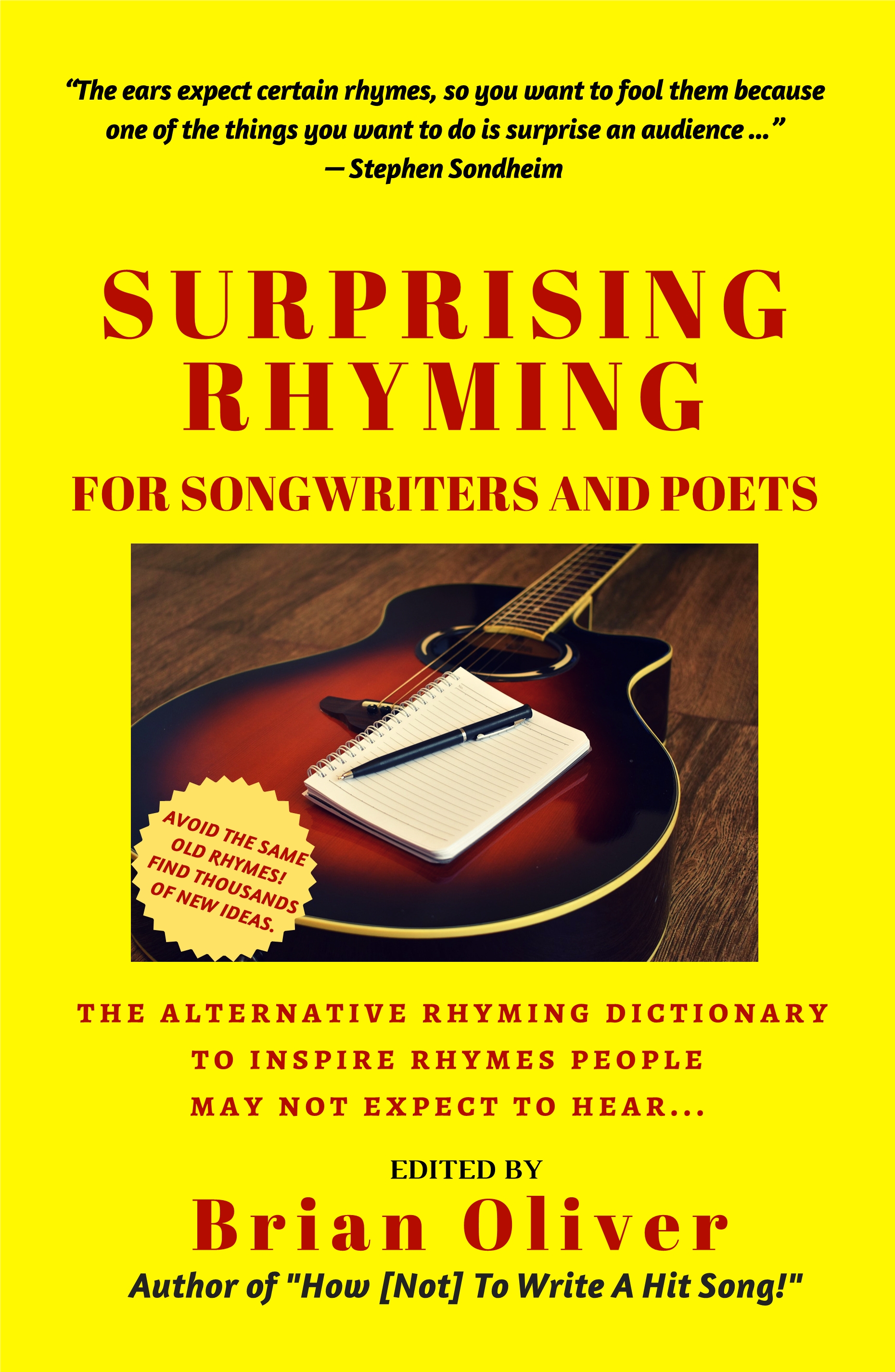 “SURPRISING RHYMING” – The Alternative Rhyming Dictionary for Songwriters and Poets – is available from Amazon as a US paperback, a UK paperback, and across Europe. It is also available as an eBook from Amazon’s Kindle store in the United States, the UK and Europe, as well as Apple’s iTunes Book Store, Barnes & Noble’s Nook Store and Rakuten’s KoboBooks.
![“HOW [NOT] TO WRITE A HIT SONG! - 101 COMMON MISTAKES TO AVOID IF YOU WANT SONGWRITING SUCCESS” is available from Amazon as a paperback and also as an eBook from Amazon’s Kindle Store, Apple's iTunes Store, Barnes and Noble's Nook store, and from KoboBooks.com.](https://thehitformula.com/wp-content/uploads/2013/05/how-not-to-write-a-hit-song-smashwords-cover-blog-widgit-188x282.jpg) A 5-star rated book at Amazon, “How [Not] To Write A Hit Song! – 101 Common Mistakes To Avoid If You Want Songwriting Success” is available from Amazon as a US paperback, a UK paperback and as an eBook from Amazon’s Kindle Store. It is also available from Apple’s iTunes Book Store, Barnes & Noble’s Nook store, and Rakuten’s KoboBooks.
A 5-star rated book at Amazon, “How [Not] To Write A Hit Song! – 101 Common Mistakes To Avoid If You Want Songwriting Success” is available from Amazon as a US paperback, a UK paperback and as an eBook from Amazon’s Kindle Store. It is also available from Apple’s iTunes Book Store, Barnes & Noble’s Nook store, and Rakuten’s KoboBooks.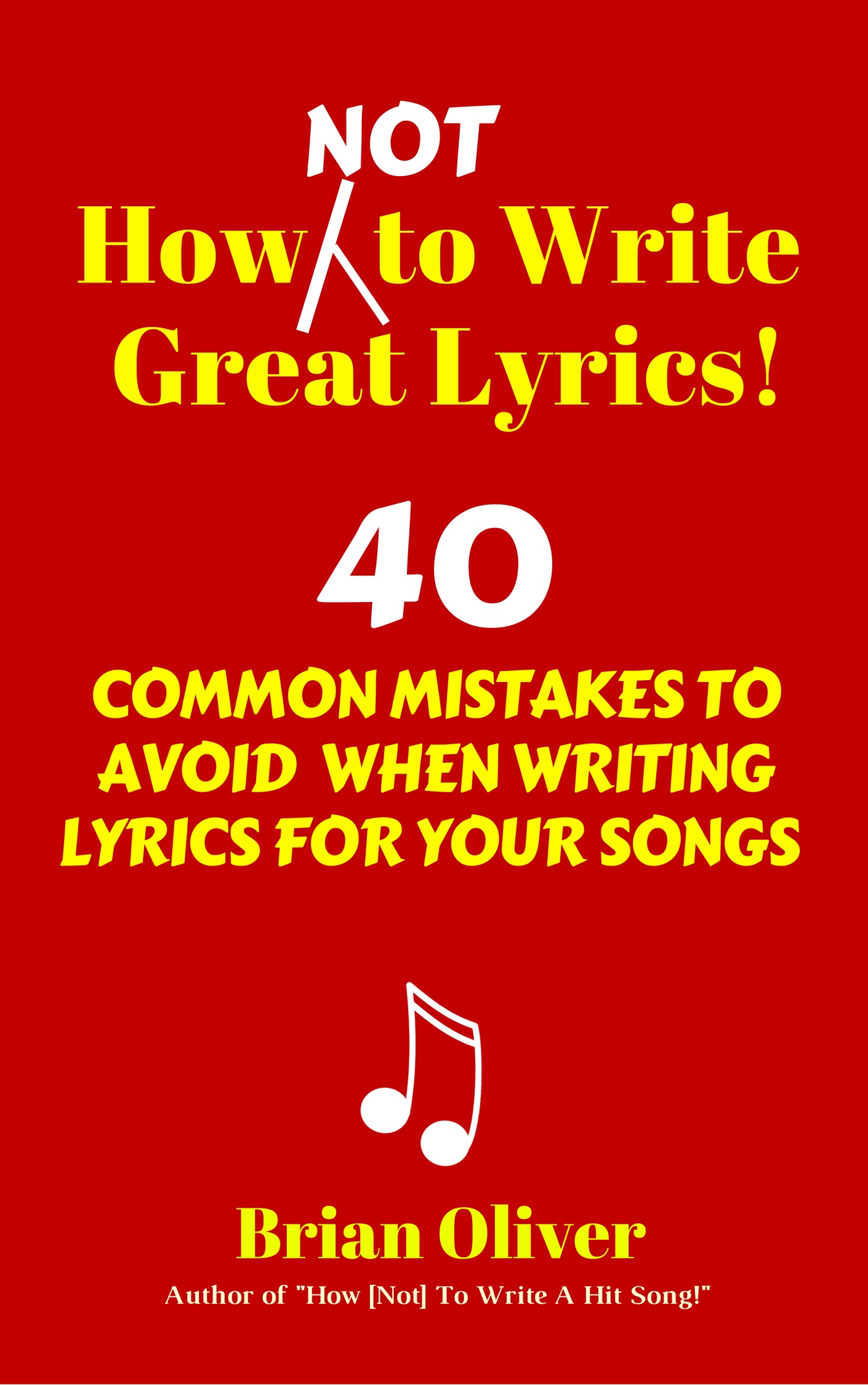 “How [Not] To Write Great Lyrics! – 40 Common Mistakes To Avoid When Writing Lyrics For Your Songs” is available from Amazon and Barnes & Noble as a US paperback, UK paperback and as an eBook from Amazon’s Kindle Store. It is also available from Apple’s iTunes Book Store, Barnes & Noble’s Nook store, and Rakuten’s KoboBooks.

![“HOW [NOT] TO WRITE A HIT SONG! - 101 COMMON MISTAKES TO AVOID IF YOU WANT SONGWRITING SUCCESS” is available from Amazon as a paperback and also as an eBook from Amazon’s Kindle Store, Apple's iTunes Store, Barnes and Noble's Nook store, and from KoboBooks.com.](https://thehitformula.com/wp-content/uploads/2013/05/how-not-to-write-a-hit-song-smashwords-cover-blog-widgit-188x282.jpg?w=100) A 5-star rated book at Amazon, “How [Not] To Write A Hit Song! – 101 Common Mistakes To Avoid If You Want Songwriting Success” is available from Amazon as a US paperback, UK paperback and as an eBook from Amazon’s Kindle Store. It is also available from Apple’s iTunes Store (Books/Arts & Entertainment/Music), Barnes & Noble’s Nook store, and Rakuten’s KoboBooks.
A 5-star rated book at Amazon, “How [Not] To Write A Hit Song! – 101 Common Mistakes To Avoid If You Want Songwriting Success” is available from Amazon as a US paperback, UK paperback and as an eBook from Amazon’s Kindle Store. It is also available from Apple’s iTunes Store (Books/Arts & Entertainment/Music), Barnes & Noble’s Nook store, and Rakuten’s KoboBooks.
 From Paul Weller’s emergence as a songwriting force with the power punk of The Jam in the 1970s to the soul sounds of The Style Council in the 1980s—followed by many diverse solo albums since—he has continually evolved his approach to songwriting. Weller warns that writers who don’t seek new challenges risk simply repeating themselves and could start to bore their listeners as a result.