As experienced songwriters know, you only have a limited amount of time in which to grab a listener’s attention and create a lasting impression on them. If your song structure and lyrics are too complicated and difficult to understand, listeners may find it hard to grasp what you’re trying to communicate to them … and they could soon lose interest in the song.
The Foo Fighters’ frontman Dave Grohl compares this challenge to trying to solve a Rubik’s Cube. “You have to try to find a melody and lyric that will braid together and create four minutes of memory that you’ll have for the rest of your life,” he explained in a recent Billboard Chart Beatpodcast.
“To me, the challenge is always trying to craft a song that is simple in a way that people will connect to it emotionally,” he said. “Even just a melody … that’s a funny thing. A lyric is one thing, but there’s something that a melody can do … just the sound of a minor scale, or a major scale rising in a chorus. The notes will twist your heart.”
As Dave Grohl acknowledges, for a song to become a great song it must be able to reach out and touch listeners and stimulate an emotional response within them. It should make them feel something and take them on an emotional journey.
The great George Gershwin once described songwriting as “an emotional science”, and scientific studies have shown that a wide range of notes can imply joy or uneasiness, while a narrower range of notes can suggest tranquillity, sadness or triumph.
Major chords often convey happiness or joy, while minor chords are associated with sadness. Using a mix of minor chords and major chords can add extra depth and colour to a song. But chord progressions should not be so complicated that they don’t flow properly and end up wandering aimlessly.
And remember, a song should contain only one story, or one message, told from a single point of view. Lyrically, you can avoid confusing the listener by using the viewpoint character’s thoughts and perceptions to drive the song.
New songwriters, who are still developing their craft, often fall into the trap of believing that every line of their song has to be clever or tricky in order to make an impression on the listener. What they should really be focusing on is making sure that the structure of their song is clear, simple and easy to follow. This will make it easier for people to feel an emotional connection with the song.
As Dave Grohl suggests, even within a simple song form the use of certain chord progressions and recurring sequences of notes can have an emotional effect on the listener. The Foo Fighters’ classic song “Times Like These” is a great example of this …
It is also available as an eBook from Amazon’s Kindle store in the United States, the UK, Canada, Australia, and across Europe—as well as Apple Books, Barnes & Noble and Rakuten’s KoboBooks.
“SURPRISING RHYMING” – The Alternative Rhyming Dictionary for Songwriters and Poets – is available from Amazon as a US paperback, a UK paperback, and across Europe. It is also available as an eBook from Amazon’s Kindle store in the United States, the UK and Europe, as well as Apple’s iTunes Book Store, Barnes & Noble’s Nook Store and Rakuten’s KoboBooks.
A 5-star rated book at Amazon, “How [Not] To Write A Hit Song! – 101 Common Mistakes To Avoid If You Want Songwriting Success” is available from Amazon as a US paperback, a UK paperback and as an eBook from Amazon’s Kindle Store. It is also available from Apple’s iTunes Book Store, Barnes & Noble’s Nook store, and Rakuten’s KoboBooks.
“How [Not] To Write Great Lyrics! – 40 Common Mistakes To Avoid When Writing Lyrics For Your Songs” is available from Amazon and Barnes & Noble as a US paperback, UK paperback and as an eBook from Amazon’s Kindle Store. It is also available from Apple’s iTunes Book Store, Barnes & Noble’s Nook store, and Rakuten’s KoboBooks.
“HOW [NOT] TO WRITE SONGS IN THE STREAMING AGE – 40 MISTAKES TO AVOID IF YOU WANT TO GET MORE STREAMS” - This book shows how the dominance of music streaming is having a profound impact on songwriting and the structure of songs. Songs that connect in the streaming world are no longer the same as songs that work on traditional media, like radio. Successful streaming now requires a different type of song. This means songwriters who want more plays on streaming platforms need to rethink their songwriting approach in order to meet the specific needs of streaming audiences. This book aims to provide a better understanding of the new building blocks of song structure in the streaming age. It examines essential elements found in the construction, melodies and lyrics of the biggest streaming hits – and highlights the most common errors made when these key components are built into a song. To help new songwriters avoid such mistakes in their own songs, the book provides 40 insightful tips and a comprehensive Checklist for creating more streaming-friendly songs. The book is now available from Amazon as a paperback and eBook, and also from leading eBook retailers like Apple Books, Kobo and Barnes & Noble.
‘HOW (NOT) TO WRITE A HIT SONG! – 101 COMMON MISTAKES TO AVOID IF YOU WANT SONGWRITING SUCCESS’
With a 5-star rating at Amazon, this book takes a close look at the essential elements that are consistently found in the structure, melodies and lyrics of all hit songs.
It highlights the most common errors that are made when these key components are built into a song, so that new writers can try to avoid such mistakes in their own songs.
Most writers have had to endure the disappointment of having their songs rejected, and ended up asking: “Could I have done more to make my songs better?”.
“How [Not] To Write A Hit Song!” aims to help writers recognize weaknesses in their songs, so they can re-work them, make them stronger, and hopefully achieve the breakthrough they’re striving for.
The book includes a detailed checklist of 101 common mistakes that writers can measure their own songs against.
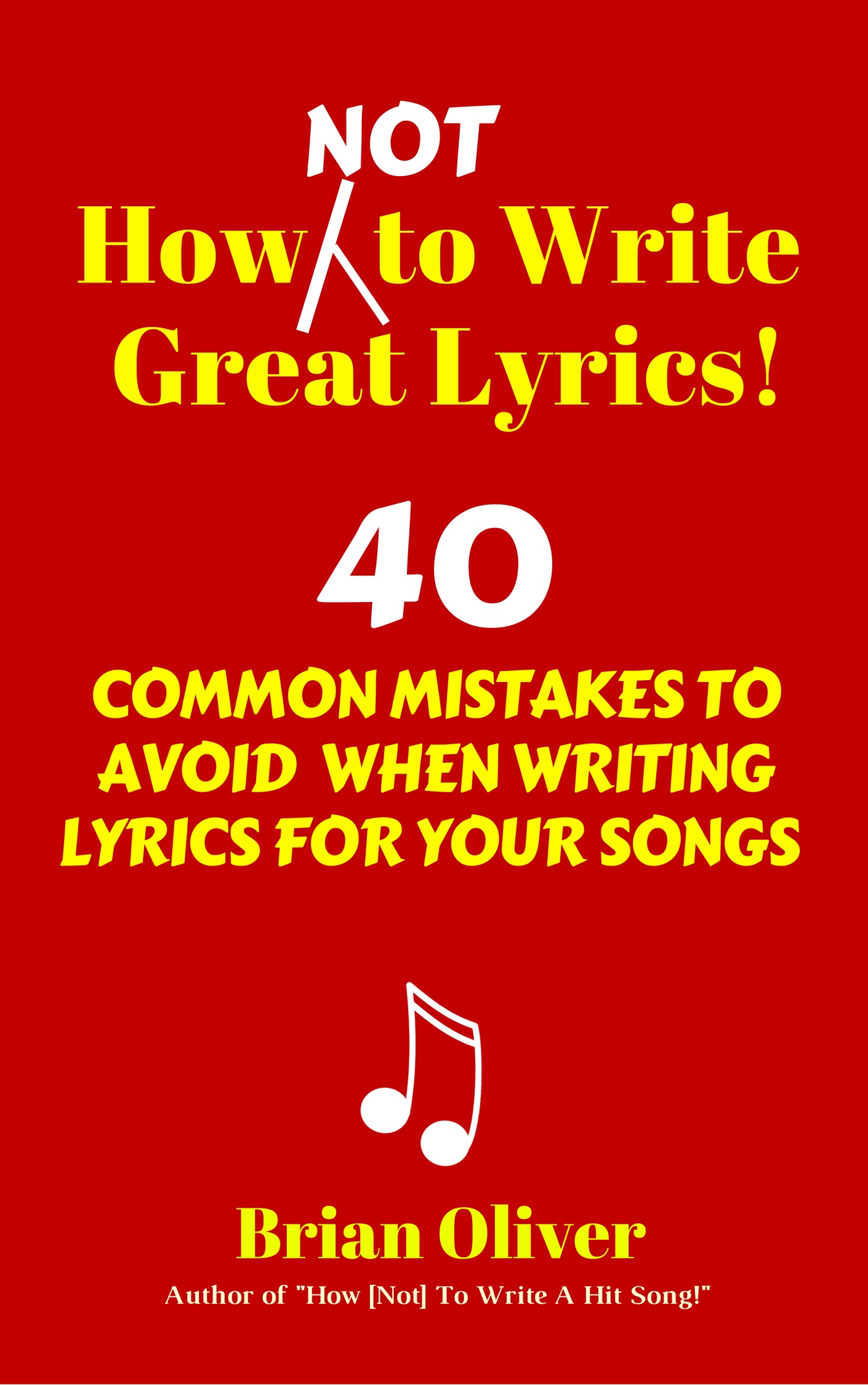
“HOW (NOT) TO WRITE GREAT LYRICS! 40 COMMON MISTAKES TO AVOID WHEN WRITING LYRICS FOR YOUR SONGS”
The 40 most common lyric writing mistakes are exposed in this new book by experienced music publisher and music consultant Brian Oliver.
Written in an easy, non-technical style, the book identifies the most frequent causes of lyric writing problems and aims to help aspiring songwriters steer clear of the many traps that they can easily fall into when writing lyrics for their songs.
“How [Not] To Write Great Lyrics!” gives new writers a wide range of valuable advice – from how to prevent common errors in the basic construction of their song lyrics … through to the perils of making bad choices when it comes to titles, opening lines, lyrical hooks, verb selection, clichés, rhyming patterns, and many other issues.
The book includes a comprehensive checklist of more than 100 potential hazards that writers can measure their own lyrics against.
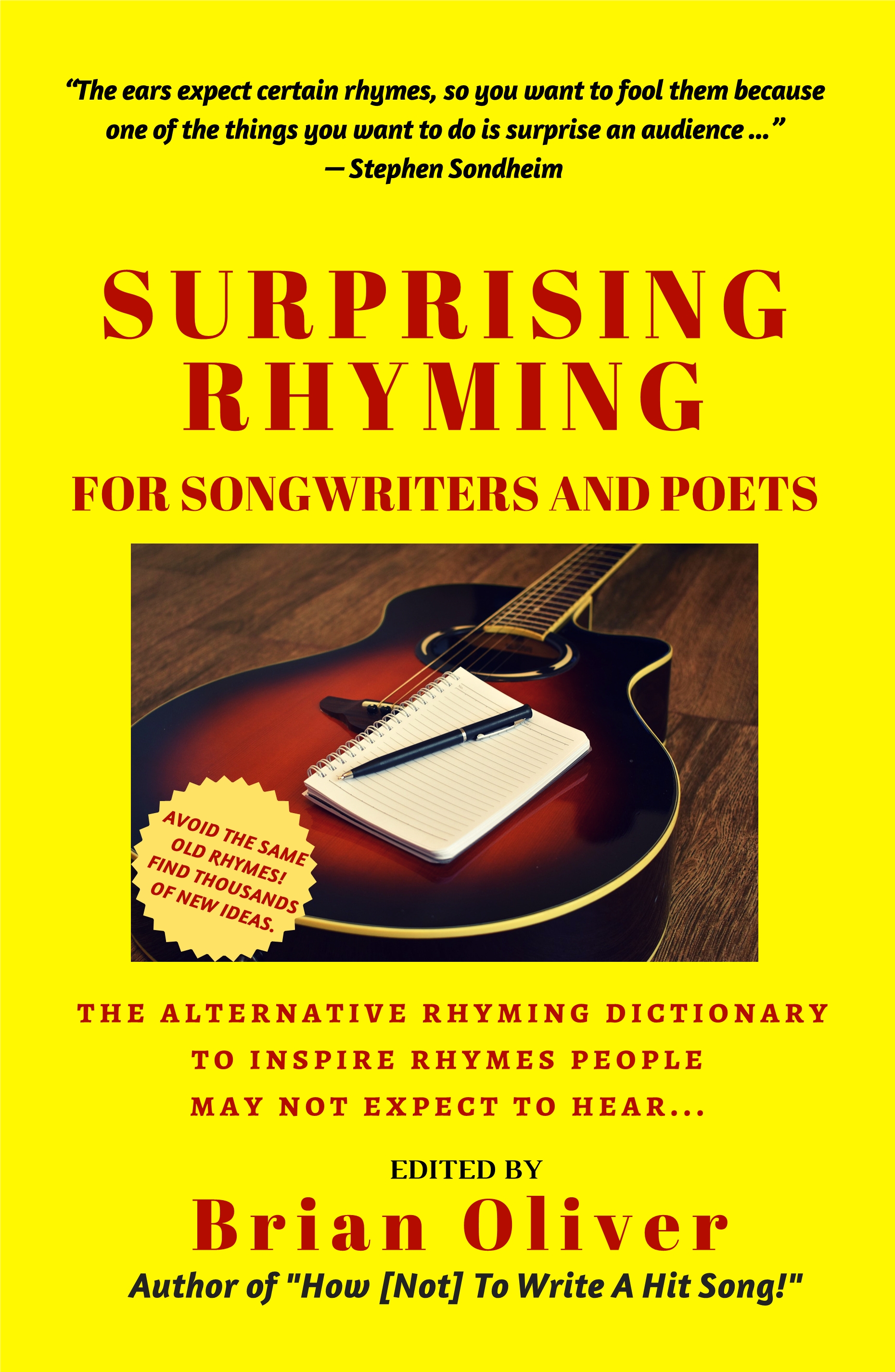
“SURPRISING RHYMING FOR SONGWRITERS AND POETS -THE ALTERNATIVE RHYMING DICTIONARY”
With more new songs being written than ever before, songwriters are finding it harder to sound original and craft rhymes that have not already been used. “SURPRISING RHYMING” is a new kind of rhyming dictionary that aims to make it easier for writers to avoid clichés and create rhymes people may not have heard before.
Based on an in-depth study of the ingenious rhymes used by some of the world’s greatest songwriters and lyricists, this book offers an astonishing array of thousands of alternative rhyme options. It contains rhyme types much broader than those found in traditional rhyming dictionaries which tend to stick to ‘perfect’ rhymes. Instead, it focuses on ‘imperfect’ rhymes that are less predictable than ‘pure’ rhymes—and are therefore more likely to surprise an audience. The book also includes many new words that have been added to standard dictionaries in recent years.
With 624 pages, the book is laid out clearly to make it quick and easy to find the perfect word to achieve a memorable rhyme. There are separate sections for one-, two- and three-syllable rhymes, along with many useful tips on rhyming.
“SURPRISING RHYMING” is available from Amazon as a paperback and an eBook. It’s also available as an eBook from Apple’s iTunes Store, Barnes & Noble and Rakuten’s KoboBooks.