 by Brian Oliver
An extract from his new book, “Surprising Rhyming for Songwriters and Poets”, an alternative rhyming dictionary designed to help writers create unique rhymes and avoid tired old clichés. It contains over 150,000 rhyming solutions for some 1,400 different rhyme sounds.
 As a music publisher I’ve listened to thousands of demos by aspiring songwriters and, despite always hoping to discover a fresh new talent, I’ve ended up feeling disappointed because I found I could predict what the next rhyme was going to be on almost every line. Inexperienced writers often weaken a potentially good song by going for the easiest and most obvious rhyme, or by using the same rhyme sound too many times in a row. This simply makes the lyrics sound boring, monotonous and colorless. As the legendary Broadway composer and lyricist Stephen Sondheim once remarked: “The ears expect certain rhymes, so you want to fool them because one of the things you want to do is surprise an audience.”
It’s not enough to simply go through the alphabet trying to think of words that rhyme—irrespective of whether the chosen word helps to underpin the meaning of your song and drive the story forward. This lazy approach usually results in worn-out, clichéd rhymes that we’ve all heard countless times before.
Lyrics don’t always have to rhyme, of course, but rhyming is a mnemonic device that assists the memory and makes it easier for people to remember a song. Rhyming also plays an important part in giving a lyric a sense of form and symmetry.
“In a couplet, the first rhyme is like a question to which the second rhyme is an answer,” explains English poet James Fenton, a former Professor of Poetry at Oxford University. “In most quatrains [four-line verses], space is created between the rhyme that poses the question and the rhyme that gives the answer … it’s like a pleasure deferred.”
Historically, many pop songs in the rock era have featured ‘perfect’ rhymes where a one-syllable word is rhymed with another one-syllable word (such as ‘kiss’ and ‘miss’), or where two words have the same spelling in the last syllable (such as ‘love and ‘above’).
But perfect rhymes tend to get tedious. And many of the cleverest perfect rhymes have been used so many times over the years that they’ve now become clichés.
Hit songwriting is more sophisticated these days, and publishers and A&R reps have much higher expectations of lyricists. So, if you have a rhyme in your head, ask yourself if you’ve heard it before. If it sounds too familiar, try finding another way of saying it—perhaps by using a metaphor rather than just a literal rhyme, or an off-the-wall ‘imperfect’ rhyme.
Sometimes, simply putting an unexpected adjective or a visual descriptor (like Homer’s “rosy-fingered dawn” and “wine-dark sea”) in front of a clichéd rhyming noun can surprise the listener and make the cliché sound less familiar.
You can often create a much greater impact by rhyming words that don’t have the same combination of letters but sound similar (such as ‘clown’ and ‘around’, or ‘made’ and ‘late’). This is because lyrics are meant for the ears, so how words sound is more important than how they’re written. It’s the similarity between the sound of the syllables (for example, ‘rougher’ and ‘suffer’) that creates the rhyme and engages the listener, rather than the words themselves.
 “Rhyming doesn’t have to be exact anymore,” Bob Dylan told Paul Zollo of American Songwriter magazine in a 2012 interview. “It gives you a thrill to rhyme something and you think, ‘Well, that’s never been rhymed before’. Nobody’s going to care if you rhyme ‘represent’ with ‘ferment’, you know. Nobody’s gonna care.”
Dylan once admitted to Rolling Stone magazine that he stunned himself when he wrote the first two lines of ‘Like a Rolling Stone’ and rhymed “kiddin’ you” with “didn’t you”. “It just about knocked me out,” he said.
In fact, many established songwriters now try to steer clear of perfect rhymes because they’ve recognized that rhymes that are too exact can sometimes limit the expression of true emotion. Using imperfect rhymes to create word pictures—or to convey what you want to say more accurately—can often be much more effective than pure rhymes.
With imperfect rhymes (also referred to as false-rhymes, half-rhymes, slant-rhymes or near-rhymes), the vowel sounds are identical, but the consonants that follow or precede those vowel sounds are different and don’t match. For example: ‘forever’ and ‘together’, ‘time’ and ‘mind’, or ‘make’ and ‘fate’. The matching vowels are enough to make the rhyme work.
When people hear the word ‘man’, for example, they will naturally expect to hear something like ‘can’ or ‘ran’ as the rhyme. If you unexpectedly slip in a rhyme that has an extra consonant at the end (for example, the word ‘stand’), they may listen more closely to hear what comes next.
Unpredictable rhymes can also be created by varying the rhyme sounds in your choice of words. For example, a single-sound rhyme in a multi-syllable word (such as ‘indicate’ and ‘celebrate’ or ‘fingernail’ and ‘fairy tale’), You can also use double-sound rhymes (‘walking’ and ’talking’), or triple-sound rhymes (‘addiction’ and ‘prediction’).
Instead of rhyming a noun with a noun, or a verb with a verb, you can also create an unexpected rhyme by pairing different parts of speech, such as a noun and an adjective (for example, ‘guess’ and ‘pointless’).
 Many experienced writers feel that using imperfect rhymes gives them greater freedom and flexibility to create word pictures. It also provides an ingenious way to avoid employing rhyming clichés or rhymes that are too obvious. For example, in her award-winning 2013 song ‘Brave’ (co-written with Jack Antonoff), Sara Bareilles (left) rhymes ‘outcast’ with ‘backlash’, ‘inside’ with ‘sunlight’, ‘there’ with ‘stared’, and ‘run’ with ‘tongue’.
Imperfect rhymes have always been used in hip-hop in conjunction with assonance (the repetition of vowel sounds to create internal rhyming within lyric lines). In one section of his 1992 song ‘N.Y. State of Mind’, rapper Nas manages to rhyme the word ‘prosperous’ with the words ‘dangerous’, ‘blamin’ us’ and ‘hostages’.
If you study the latest chart hits and compare where the rhymes are positioned—and what kind of rhymes are being used—you’re likely to find much looser (and more conversational) ‘near rhymes’ placed in the middle of the lines in the verse, instead of at the end of each line (which is the traditional approach).
This is partly due to the influence of hip-hop since the late 1980s. Run DMC’s classic 1986 album Raising Hell is credited with paving the way for much greater use of mid-line rhymes rather than relying on end rhymes. Although internal rhymes had been used previously, they had never been employed so consistently over a whole album as on Raising Hell.
An internal rhyming pattern involves repeating vowels and consonants (and combinations of both) within each individual line. A good example of this is Phil Lynott’s classic Thin Lizzy song ‘With Love’ which includes the line: “I must confess that in my quest I felt depressed and restless”.
Using mid-line rhymes in this way helps to build the lyrical rhythm and can strengthen the forward motion of the verse.
You can surprise listeners by having your internal rhyme fall on the second or third syllable of a multi-syllable word instead of at the end—for example, by putting the rhyme on the syllable that is stressed most strongly in normal speech (such as ‘unachievable’ and ‘believable’).
You can also rhyme a multi-syllable word with a word that only has one syllable (such as ‘sublime’ and ‘time’).
 In 1987, acclaimed hip-hop lyricist Rakim (right) pioneered the multi-syllabic approach to rhyming with compound rhymes that paired one word with two words, such as ‘righteous’ and ‘might just’. It was a style (since adopted by other rappers) that introduced a rapid, continuous, rhythmic flow, based on deeply-woven rhyme structures that incorporated internal rhymes.
Since then, pop music has absorbed the rhyming patterns and inventive near-rhymes and multi-syllabic rhymes used in hip-hop in a very real way.
Today, Eminem (who has admitted he often spends hours studying a rhyming dictionary) tends to fill his songs with more internal rhymes than anyone else in contemporary pop. He once told Rolling Stone magazine: “Even as a kid, I always wanted the most words to rhyme. If I saw a word like ‘transcendalistic tendencies’, I would write it out on a piece of paper and underneath I’d line a word up with each syllable. Even if it didn’t make sense, that’s the kind of drill I would do.”
Consistency is essential when it comes to creating impactful rhyming schemes. For example, if you use internal rhymes in the first verse, you should put them in the same place in the subsequent verses in order to maintain the kind of symmetry that listeners like to hear.
My new book, Surprising Rhyming, is a new kind of rhyming dictionary that aims to make it easier for writers to avoid clichés and craft rhymes that people may not have heard before. It contains rhyme types that are much broader than those found in traditional rhyming dictionaries which tend to show only ‘perfect’ or ‘true’ rhymes.
For example, if you’re looking for a rhyme for the word “true”, rhyming dictionaries typically offer perfect rhymes such as “blue”, “due”, “knew” or “who”. Instead, Surprising Rhyming also pairs “true” more imaginatively with words like “gloom”, “soon”, “groove” and “dude”.
If you need a rhyme for the word “gamble”, you’ll normally be offered “ramble”, “scramble” or “shamble”. But Surprising Rhyming’s solutions also include: “bangle”, “dangle”, “candle” and “handle”.
Surprising Rhyming includes over 150,000 rhyming solutions for some 1400 different rhyme sounds. These are based on the findings of an in-depth study of the kind of ingenious ‘near’ rhymes used by influential songwriters and lyricists such as: Chuck Berry, David Bowie, Sara Bareilles, James Bay, Leonard Cohen, Bob Dylan, Sia Furler, Hozier, Jay-Z, Billy Joel, Carole King, Michael Kiwanuka, John Lennon, Lorde, John Mayer, Joni Mitchell, Paul McCartney, Van Morrison, Bonnie McKee, Randy Newman, Dolly Parton, Christina Perri, Katy Perry, Ed Sheeran, Paul Simon, Stephen Sondheim, Taylor Swift, Cat Stevens, Bernie Taupin, James Taylor, Jimmy Webb, Lucinda Williams, Stevie Wonder … and many more.
Even when you’re using a rhyming dictionary like “Surprising Rhyming“ as a creative brainstorming tool, don’t always go for the most obvious rhyme word. By digging deeper, you can often discover rhymes that inspire new themes or fresh ideas that can take your lyrics in a more exciting (and less predictable) direction.
So challenge yourself … Surprise your audience!
# # # #
“SURPRISING RHYMING” – The Alternative Rhyming Dictionary for Songwriters and Poets – is available from Amazon as a US paperback, a UK paperback, and across Europe. It is also available as an eBook from Amazon’s Kindle store in the United States, the UK and Europe, as well as Apple’s iTunes Store, Barnes & Noble’s Nook Store and Rakuten’s KoboBooks.
Read a FREE sample of the book HERE (USA) … HERE (UK) … HERE (CANADA).
![“HOW [NOT] TO WRITE A HIT SONG! - 101 COMMON MISTAKES TO AVOID IF YOU WANT SONGWRITING SUCCESS” is available from Amazon as a paperback and also as an eBook from Amazon’s Kindle Store, Apple's iTunes Store, Barnes and Noble's Nook store, and from KoboBooks.com.](https://thehitformula.com/wp-content/uploads/2013/05/how-not-to-write-a-hit-song-smashwords-cover-blog-widgit-188x282.jpg?w=145&h=218) A 5-star rated book at Amazon, “How [Not] To Write A Hit Song! – 101 Common Mistakes To Avoid If You Want Songwriting Success” is available from Amazon as a US paperback, a UK paperback and as an eBook from Amazon’s Kindle Store. It is also available from Apple’s iTunes Store, Barnes & Noble’s Nook store, and Rakuten’s KoboBooks.
A 5-star rated book at Amazon, “How [Not] To Write A Hit Song! – 101 Common Mistakes To Avoid If You Want Songwriting Success” is available from Amazon as a US paperback, a UK paperback and as an eBook from Amazon’s Kindle Store. It is also available from Apple’s iTunes Store, Barnes & Noble’s Nook store, and Rakuten’s KoboBooks.
Read a FREE sample of the book HERE (USA), HERE (UK), HERE (Australia) and HERE (Canada).
 “How [Not] To Write Great Lyrics! – 40 Common Mistakes To Avoid When Writing Lyrics For Your Songs” is available from Amazon and Barnes & Noble as a US paperback, UK paperback and as an eBook from Amazon’s Kindle Store. It is also available from Apple’s iTunes Store, Barnes & Noble’s Nook store, and Rakuten’s KoboBooks.
Read a FREE sample of the book HERE (USA), HERE (UK), HERE (Australia) and HERE (Canada).
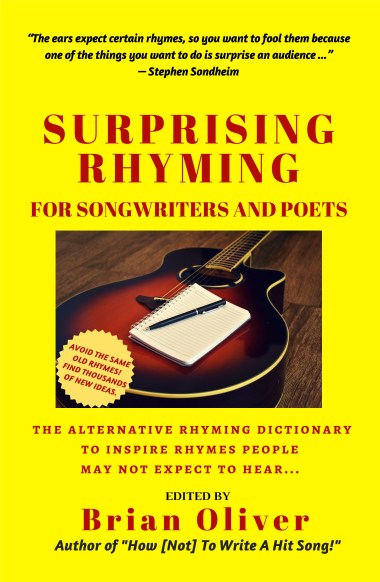
With more new songs being written every week than ever before, songwriters are finding it harder to sound original and find rhymes and phrases that have not already been used. Now, a new kind of rhyming dictionary—titled Surprising Rhyming—aims to make it easier for writers to avoid clichés and craft rhymes that people may not have heard before.
Built on the findings of an in-depth study of the kind of ingenious rhymes used by some of the world’s greatest songwriters and lyricists, Surprising Rhyming offers an astonishing array of alternative rhyme options. Its 624 pages contain over 150,000 rhyming solutions for some 1,400 different rhyme sounds. These rhyme types are much broader than those found in traditional rhyming dictionaries which tend to show only ‘perfect’ or ‘true’ rhymes.
Using too many perfect rhymes can sometimes make a lyric sound tedious and predictable—and prone to clichés. To avoid this, Surprising Rhyming focuses instead on off-the-wall false-rhymes, half-rhymes, slant-rhymes and near-rhymes that are less predictable than exact rhymes … and are therefore more likely to surprise an audience.
The book also includes many new words that have been added to standard dictionaries in recent years.
The thousands of ‘surprising’ rhymes crammed into Surprising Rhyming’s pages are based on analyses of the unconventional ‘imperfect’ rhymes that have been used by influential songwriters and lyricists such as: Chuck Berry, David Bowie, Sara Bareilles, James Bay, Leonard Cohen, Bob Dylan, Sia Furler, Hozier, Jay-Z, Billy Joel, Carole King, Michael Kiwanuka, John Lennon, Lorde, John Mayer, Joni Mitchell, Paul McCartney, Van Morrison, Bonnie McKee, Randy Newman, Dolly Parton, Christina Perri, Katy Perry, Ed Sheeran, Paul Simon, Stephen Sondheim, Taylor Swift, Cat Stevens, Bernie Taupin, James Taylor, Jimmy Webb, Lucinda Williams, Stevie Wonder … and many more.
The concept of the book was inspired by a remark made by Stephen Sondheim, the legendary Broadway composer and lyricist. In a PBS News Hour interview, Sondheim described how people’s ears have come to expect certain rhymes and suggested that writers should try to fool their audience by coming up with rhymes that will take listeners by surprise.
The ‘surprising’ rhymes listed in this book are typically formed by words with similar but not identical sounds (such as rain/blame or day/late) rather than the more predictable ‘perfect’ rhymes found in traditional rhyming dictionaries (like rain/pain or day/stay).
For example, if you’re looking for a rhyme for the word “true”, rhyming dictionaries typically offer perfect rhymes such as “blue”, “due”, “knew” or “who”. Instead, Surprising Rhyming pairs “true” more imaginatively with words like “smooth”, “tune”, “gloom”, “soon” and “groove”.
If your rhyme word is “suffer”, traditional rhyming dictionaries offer rhymes like “rougher”, “tougher” or “buffer”. Surprising Rhyming’s alternative suggestions for “suffer” include: “lover”, “brother”, “summer”, “discover” and “another”.
And if you need a rhyme for the word “gamble”, you’ll normally be offered “ramble”, “scramble” or “shamble”. But Surprising Rhyming’s solutions also include: “bangle”, “dangle”, “candle” and “handle”.
“Surprising Rhyming is a new kind of rhyming dictionary that encourages writers to be more adventurous in their approach to rhyming,” explained the book’s creator and editor, Brian Oliver, author of the five-star rated book How [Not] to Write a Hit Song! 101 Common Mistakes to Avoid If You Want Songwriting Success.
He said: “Many of the cleverest perfect rhymes have been used so many times over the years that they’ve now become tired clichés and writers often struggle to find rhymes or phrases that haven’t been heard before. As a brainstorming tool, Surprising Rhyming is designed to enable writers to challenge themselves and make their rhymes bolder and more original … and less predictable.”
The book is laid out clearly to make it quick and easy to find the perfect word to achieve a memorable rhyme. There are separate sections for one-, two-, three- and four-syllable rhymes, along with many useful tips on rhyming.
“SURPRISING RHYMING” – The Alternative Rhyming Dictionary for Songwriters and Poets – is available from Amazon as a US paperback, a UK paperback, and across Europe. It is also available as an eBook from Amazon’s Kindle store in the United States, the UK and Europe, as well as Apple’s iTunes Store, Barnes & Noble’s Nook Store and Rakuten’s KoboBooks.
Read a free sample of the book HERE (USA) … HERE (UK) … HERE (CANADA).
# # # #
 Songwriters Hall of Fame chairman Jimmy Webb has announced that Elton John and Bernie Taupin will be the 2013 recipients of the prestigious Johnny Mercer Award at this year’s awards ceremony in New York on June 13.
John and Taupin have been one of the most prolific and successful songwriting partnerships of all time. Their award-winning relationship has spanned more than four decades and they have collaborated on more than 30 albums since they first met in 1967.
“Some catalogues are more significant than others not only because of their pertinence to the times in which they were written, but because their sheer mass is overpowering,” said Jimmy Webb. “It’s just not that easy to write 40 top 10 records. It’s kind of like swimming the English Channel with your hands tied behind your back.”
He added: “Elton’s readily identifiable melodic piano style has proven to be a perfect accompaniment to Bernie’s razor sharp lyrics about relationships and living on the edge of life both in good and bad times.”
The Johnny Mercer Award is the highest honour bestowed by the Songwriters Hall of Fame. It is exclusively reserved for songwriters or songwriting teams who have already been inducted in a prior year, and whose body of work is of such high quality and impact that it upholds the gold standard set by the legendary Johnny Mercer.
Past Johnny Mercer Award recipients have included songwriting giants: Barry Mann and Cynthia Weil, Phil Collins, Holland-Dozier-Holland, Paul Anka, Dolly Parton, Kris Kristofferson, Smokey Robinson, Stevie Wonder, Carole King, Billy Joel, Jimmy Webb, Hal David, Burt Bacharach, Jerry Leiber, Mike Stoller, Paul Simon, Alan and Marilyn Bergman, Stephen Sondheim, Cy Coleman, Sammy Cahn and Jule Styne.
# # # #
 ‘How (Not) To Write A Hit Song! – 101 Common Mistakes To Avoid If You Want Songwriting Success’ is now available from Amazon’s Kindle Store for only US$7.22 or GB£4.78.
Read a FREE sample of the book HERE (USA) and HERE (UK).
Also available from Apple’s iTunes Store (Books/Arts & Entertainment/Music).



 SONGWRITING: THE HIT FORMULA