 “Rhyming doesn’t have to be exact anymore,” Bob Dylan told Paul Zollo of American Songwriter magazine in a 2012 interview. “It gives you a thrill to rhyme something and you think, ‘Well, that’s never been rhymed before’. Nobody’s going to care if you rhyme ‘represent’ with ‘ferment’, you know. Nobody’s gonna care.”
Dylan once admitted to Rolling Stone magazine that he stunned himself when he wrote the first two lines of ‘Like a Rolling Stone’ and rhymed “kiddin’ you” with “didn’t you”. “It just about knocked me out,” he said.
Historically, many classic pop songs from the rock era have tended to feature ‘perfect’ rhymes where a one-syllable word is rhymed with another one-syllable word (such as ‘kiss’ and ‘miss’), or where two words have the same spelling in the last syllable (such as ‘love and ‘above’).
These days, it’s best to steer clear of perfect rhymes, if you can, because rhymes that are too exact can often limit the expression of true emotion.
You can create a much greater impact by rhyming words that don’t have the same combination of letters but sound similar (such as ‘clown’ and ‘around’, or ‘made’ and ‘late’). This is because sound-alike words tend to engage listeners more than words with the same spelling, as in the case of Dylan’s “kiddin’ you” and “didn’t you”.
Using ‘false’ rhymes that create word pictures – or which convey what you want to say more accurately – can often be much more effective than pure rhymes.
It’s not enough to simply go through the alphabet looking for words that rhyme, irrespective of whether or not the chosen word helps to underpin the meaning of your song and drive the story forward. This approach usually results in clichéd rhymes that we’ve all heard many times before.
You can surprise the listener by having the rhyme fall on the second or third syllable of a multi-syllable word instead of at the end (for example, put the rhyme on the syllable that is stressed most strongly in normal speech, such as ‘unachievable’ and ‘believable’).
You can also rhyme a multi-syllable word with a word that only has one syllable (such as ‘sublime’ and ‘time’). This device can make a lyric much more interesting.
So don’t weaken a potentially good song by going for the easiest and most obvious rhyme. These days, lyricists have to be much more adventurous. Challenge yourself and make your rhymes less predictable.
As the great Stephen Sondheim once remarked: “The ears expect certain rhymes, so you want to fool them because one of the things you want to do in a song is surprise an audience.”
# # # #
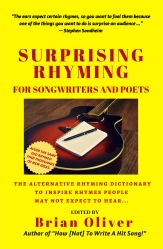 “SURPRISING RHYMING” – The Alternative Rhyming Dictionary for Songwriters and Poets – is available from Amazon as a US paperback, a UK paperback, and also across Europe. Read a FREE sample of the book HERE (USA) and HERE (UK).
![“HOW [NOT] TO WRITE A HIT SONG! - 101 COMMON MISTAKES TO AVOID IF YOU WANT SONGWRITING SUCCESS” is available from Amazon as a paperback and also as an eBook from Amazon’s Kindle Store, Apple's iTunes Store, Barnes and Noble's Nook store, and from KoboBooks.com.](https://thehitformula.com/wp-content/uploads/2013/05/how-not-to-write-a-hit-song-smashwords-cover-blog-widgit-188x282.jpg?w=138&h=208)
A 5-star rated book at Amazon, “How [Not] To Write A Hit Song! – 101 Common Mistakes To Avoid If You Want Songwriting Success” is available from Amazon as a US paperback, a UK paperback and as an eBook from Amazon’s Kindle Store. It is also available from Apple’s iTunes Store (Books/Arts & Entertainment/Music), Barnes & Noble’s Nook store, and KoboBooks.
Read a FREE sample of the book HERE (USA), HERE (UK), HERE (Australia) and HERE (Canada).
 “How [Not] To Write Great Lyrics! – 40 Common Mistakes To Avoid When Writing Lyrics For Your Songs” is available from Amazon and Barnes & Noble as a US paperback, UK paperback and as an eBook from Amazon’s Kindle Store. It is also available from Apple’s iTunes Store (Books/Arts & Entertainment/Music), Barnes & Noble’s Nook store, and KoboBooks.
Read a FREE sample of the book HERE (USA), HERE (UK), HERE (Australia) and HERE (Canada).
 For a song to become a great song, it must be able to reach out and touch listeners and stimulate an emotional response within them. It should take them on a memorable and emotional journey. It should make them feel something.
That’s why Amy Grant, the Nashville-based Christian singer-songwriter, believes the greatest compliment a songwriter can receive is to have someone tell you that your song captures exactly what they’re feeling inside.
“The challenge of a songwriter is to articulate – in an accessible way – things we go through, if what you are trying to do is to make people feel connected to their own life, ” says Amy. “I’m inspired by specific situations and try to capture in a song what people feel.”
On May 14, the six-times Grammy award winner will release her first full album of all-new songs in 10 years.
Titled How Mercy Looks From Here, the new album was produced by Marshall Altman and includes guest vocalists James Taylor, Carole King, Sheryl Crow, Will Hoge, and Eric Pasley (who wrote the only song on the album not written by Grant). Amy’s husband, Vince Gill, also makes an appearance.
Watch the official video for Amy Grant’s 1991 hit ‘Good For Me’ HERE…
# # # #

“How [Not] To Write A Hit Song! – 101 Common Mistakes To Avoid If You Want Songwriting Success” is available from Amazon as a US paperback, UK paperback and as an eBook from Amazon’s Kindle Store, Apple’s iTunes Store (Books/Arts & Entertainment/Music) and Barnes & Noble’s Nook store.
Read a FREE sample of the book HERE (USA), HERE (UK), HERE (Australia) and HERE (Canada).



 SONGWRITING: THE HIT FORMULA